Wednesday, September 14, 2011

The Long Run, Part 1: The Physical

long runAh, the long run. The sacred weekend ritual of the distance runner. The indispensable cornerstone of any training cycle. The long run.

Long runs do so many amazing things for us. I'm thinking a lot about that lately because, since coming back from many months of little or no running thanks to an injury, I actually haven't done all that many. For several months I was under strict instructions not to run more than 5-6 miles at a time, and I'm just now getting back to the point where I feel confident training for something long-ish. I spent the summer running 10Ks to help me get back into shape and build up a solid base before the heavy lifting started, so, although I've done a handful of 10- and 12-milers in the last few months, it hasn't been necessary for me to do them every single week, or to push the distance much beyond that.

As I start to do more & longer long runs in preparation for Clarksburg and CIM, I'm gaining a new appreciation for the fact that this was something I used to do (and most of you have continued doing) regularly, weekly. My 12 miler a couple of Saturdays back was the first in a few weeks; when my Garmin ticked off the last mile, I slowed to a walk and was a little taken aback at first by the dull ache that settled over my entire body, especially my tibias. (Isn't it funny how, with long runs, the aftermath is usually worse than the run itself? I'd kind of forgotten that.)

I paused at my front door to stretch a little, then forced myself to sit in an ice bath for ten minutes. (Not nearly as miserable as I remembered, by the way!) I showered, then stretched some more. My tibias continued to ache; icing and wrapping them tightly in ace bandages seemed to help. (Note to self -- look into graduated compression socks.) I downed a liter of Nuun-ified water (or do you just call it "Nuun"?), then devoured an enormous Mission burrito & collapsed on the couch.

I've learned that any time you're pushing mileage up, it's never wise to put your schedule before the way your body feels. Better to take it one day at a time, to know what's on your schedule and be ready for it, but never let yourself feel irreparably bound to it. There are plenty of runs where I've finished feeling completely drained, going How the hell am I going to run xxx tomorrow, feeling the way I do now? Usually the smart thing is to tell myself, Why don't we forget about that run right now, and just focus on relaxing for a while? If we still feel awful tomorrow, we'll skip it or cut it short. And nine times out of ten, I feel fine when the time comes.

I had a six-mile tempo run planned for the subsequent Sunday and another six easy planned for Monday, but after the twelve miles on Saturday, I really needed two days off. As in, I could've pushed myself through both runs, but felt pretty sure I would've ultimately lost more mileage later in the week than I would've saved. My body just hurt, especially my tibias, and since building up lo-o-o-o-ong-distance endurance is kind of the main point of the next three months, I figured that if my body was asking (read: begging) for some extra recovery time for something it hasn't been used to lately, it was probably smart to just go with it.

So why do we do this? What do we get out of it?

Well, in terms of the ol' "practice makes perfect" mentality, long runs seem to make perfect sense for someone training for a long race like a marathon or half marathon. If you want to get good at running a long way, you should practice running a long way.

But that's clearly not all there is to it. Nearly all of us run all or most of our long-run miles considerably slower than race pace. Marathoners don't even run their full race distance, mostly topping out at a couple of runs in the low twenties per training cycle. And what of 5K & 10Kers? If they're only racing 3 or 6 miles, why do runs in the 10+ range? When you dig a little deeper, suddenly "practice makes perfect" doesn't actually hold up all that well.

I dug into this a while back when I was helping to coach long distance high school runners as part of my first teaching job. It seemed to me that if we were going to ask kids racing 1-3 miles to run an easy 10K once a week (which, for most high school kids, is REALLY FAR!), I needed to be able to justify it to them.

So, miler or marathoner, what are the physical effects of running long that will help make you a stronger, faster runner? If it hadn't been for my inquisitive kiddos, I may never have learned that long runs give you...

  • Tougher bones. As strong and hard as bone tissue is, bones are still prone to injury from repeatedly absorbing force. Gradually increasing the amount of time you continuously ask them to do it stimulates your bones to produce more tissue and become denser. The denser your bones become, the more resistant they will be to injury.
  • Tougher muscle & connective tissue. Just as with bones, muscles, tendons, & ligaments are prone to injury from absorbing force and moving in extreme or unexpected ways (as with sprains and tears). Long periods of easy running stimulate all of these tissues to become denser and stronger, making them more resistant to injury.
  • A stronger heart. Just as with skeletal muscles, increased periods of aerobic exercise stimulate cardiac muscle to become denser and stronger as well. The stronger your heart, the higher your stroke volume (how much blood your heart is able to pump out to your body with each beat). This means that your heart has to do less work to get more oxygen to your muscles.
  • More red blood cells. Red blood cells carry oxygen. On long runs, muscle tissue needs a lot of oxygen for an extended period of time, which stimulates your body to produce more red blood cells. More red blood cells mean more fuel sent to your cells more quickly.
  • More capillaries around muscle fibers. Capillaries are the tiny blood vessels that transport blood to your muscle fibers. Running long stimulates more capillaries to grow around your muscle fibers, which means more oxygen (and hence more energy) more quickly.
  • Increased myoglobin concentrations. Once the capillaries get the oxygen to your muscle fibers, myoglobin is the substance that carries the oxygen to the cells. The more myoglobin in your muscles, the more quickly more oxygen can get to your cells.
  • More and larger mitochondria. Mitochondria are the parts of your cells that use oxygen to transform fat and carbs into energy. When you run long, you send your body the message that you need access to a LOT of energy, so your body creates more & larger mitochondria in your cells, which means your body can generate more energy more quickly.
  • Increased aerobic enzyme activity. Mitochondria contain enzymes that speed up energy production; going long increases the activity of these enzymes, helping your mitochondria to create energy more efficiently. (Also, all the business with the mitochondria & enzymes is what helps increase your lactate threshold.)

Whew!

The physical effects above are likely to help out ANY runner, regardless of what distance they're training for. In addition to all that, there are some particular advantages for folks shooting for the longer stuff:

  • Fast twitch muscles acting like slow-twitch muscles. Slow-twitch muscles are the ones that help us out the most at long distances. When you continue running past the point where your slow-twitch muscles become fatigued, your body learns to recruit fast-twitch fibers and use them more like slow-twitch fibers to keep you going.
  • Increased glycogen storage. Glycogen is how your body stores carbs, which you go through a LOT of when you run long. Your body can only store a limited amount of glycogen (about twenty miles worth, more or less, for most people), but running to the point of near-depletion stimulates the muscles to store more glycogen in the future.
  • Increased reliance on fat for fuel. For all intents & purposes, your body has an unlimited amount of fat it can use for fuel. However, burning fat is a slow process, so when you’re active (ie, running), your body prefers to burn more glycogen. Running to the point that we deplete our glycogen stores helps train our bodies to rely more on fat for fuel than they really want to. The more your body burns fat, the longer your glycogen reserves will last.
  • Better form for longer. When your form is good, you're a more efficient runner. Most of us can keep up reasonably good form for a while, but the more exhausted you get, the harder it is. Going long gives you a chance to practice keeping up your form when you're really, really tired and helps to make good form more automatic.

The best part is that you get ALL these benefits running at an easy, relaxed pace. In fact, one of the biggest (and easiest to rectify) mistakes that distance runners make is running their long, easy runs too fast. While we should definitely do some race pace, tempo, & speed runs when training for something specific, those have a different purpose. In fact some of these changes (like teaching your body to burn more fat & spare glycogen) won't occur or won't occur as effectively if your heart rate is too high. (Running too hard too often also means your body will need more time to recovery and be ready to run again, so save those efforts for your hard days.) Love your long, slow runs, and they will love you back!

Next up -- the psychological & logistical benefits of long runs.

Monday, September 12, 2011

The Reason

shadowI am slowly circling the long-awaited and much-anticipated (well....by me at least) post that will reveal once and for all why, after at least ten years of swearing I would never run a marathon, I've finally decided to give it a shot. This shit is crazy complex and I want to make sure I get it right. Or some reasonable approximation thereof.
When I think about trying to explain why I'm running this race, I always seem to come back to why I run in the first place. Which is really hard to explain. I've tried to have this conversation with so many people and it never seems to go right. I just don't have a nice, tidy, soundbite that sums it all up. I don't run for health or weight loss or to memorialize someone or relax or hear myself think or get away from it all or any of that. When these conversations come up, mostly I'm like, "Um...well, I guess I like it.(?)" and people are generally like, "That's weird." And I'm like, "Yeah...yeah, it kind of is."

Then today I was reading Shut Up And Run (which, if you haven't read, you simply MUST. Unless you're easily offended or grossed out. In that case, you probably shouldn't). In today's post, Beth wrote about 1) a mountain getaway with girlfriends where they discussed taints and 2) supporting an ultra-runner friend through part of an event in her town. A quote from her friend really struck me:
“I ask myself why I do this. I don’t know. All I know is that tomorrow I will know something new about myself I did not know today when I started this.”

I think that's relevant somehow. I think it's in the mix somewhere.

Sunday, September 11, 2011

Week In Review: Sept 5 - 11

Running ShoesThis is my weekly training journal. Including it in the blog gives me a little extra accountability in the mileage department & helps me stick to my schedule. :)

9 Weeks to Clarksburg Half Marathon

12 Weeks to Cal International Marathon


Tuesday: 7 miles (3 wu + 3 x 1600 @ 10K pace w/ 400 recoveries + .25 cd) Today was the Day of Redemption for last week's Track Session from Hell. It's been touch-and-go with my shins since the 12 miler Saturday, but, as always, I figured I'd do what I could do, and if I was suffering too much, I wouldn't push things. Warm-ups are always a good predictor for me of how the workout will go, and within a couple of laps I knew that taking both Sunday and Monday off was the right call. Although it was hot and windy, so my pace was a little slow by the numbers, I still had a good, strong speed session and got all the miles in, with no pain to speak of. (Hell, I even thought about running a 4th repeat, but decided I had enough mileage planned already this week, thankyouverymuch. Maybe next time.)

Also, can we talk for a minute about how *cute* the off-season high school track kids were out at Kezar? 5 x 400 with 30 seconds rest -- oh yeah. I remember exactly how miserable and unappealing that sounded after a summer of basically sitting on my ass playing video games. ;)

Wednesday: 6 miles easy. Wednesday was originally scheduled as a rest day, but since Monday was originally 6 miles easy & I took that day off, I decided to go ahead & do the 6 on Wednesday. If I continue feeling good for the rest of the week, I'll do the rest of this week's runs as scheduled. However, given next week's schedule, that would put me at eight consecutive days of running, so it's possible I'll skip Friday's easy six and make that a rest day. We'll see.

Thursday: 9 miles (2 wu + 7 @ MP) This run actually got its own post earlier this week; my target pace was sub-8:00 / mile, which ended up being more like 8:08 with the wind on the back of the track (grrr...). I kind of wonder if this was still too hard; occasionally I'd see numbers like 7:40 & 7:45 on my Garmin on the homestretch (no wind), which is too fast. Also, running 9 miles on the track is pretty much what I imagine purgatory is probably like.

Saturday: 8 miles (3 wu + 4 tempo + 1 cd) One of the slightly tricky bits about this training cycle is making sure that I'm not focusing on the marathon in December to the exclusion of the half marathon in November. Part of the way I'm trying to address that is by doing more frequent and longer tempo / half marathon pace runs than the marathon plan strictly calls for. Technically there's a little bit of a difference between tempo pace and HMP, but for my purposes I've kind of decided to split the difference & call it good. (The alternative seems to be doing a tempo run AND a half-marathon pace run each week, in addition to a speed workout, a marathon pace run, and a long run, and that just seems like a bad idea all around.) Basically what I'm calling "tempo" pace translates into however fast I can run while staying in the 185-190 bpm range, or about 83-85% of max. I ran on the track today, so with the headwind, that ended up being about 7:37 / mile & averaging 187 bpm. (Guessing that would be somewhere in the 7:25-7:30 range with no wind.)

In contrast to the marathon pace run on Thursday, this run was actually pretty fun. I set my Garmin to auto-lap every quarter mile, which is nice because I can break up the run more or less into laps -- mentally, the self-talk goes something like, Alright, run a 1:53-55 lap. Check. Alright, run another one. Check. Oops, 1:57, pick it up just a touch. Check. It's actually a pretty great way to learn what that level of effort feels like. This was the first run I've had at this pace where I've really felt that although, yes, it's hard, and yes, it takes some effort, and no, it's not super-comfortable, I could actually see holding that pace for 13 miles. The only down side was that I'd actually wanted to do five tempo miles, but the track police came & shut everything down for a soccer game. I thought about doing one more hard one on the roads after dropping my stuff in my car, but by then I was getting cool & a bit stiff so I just jogged one more easy mile instead.

Sunday: 11 miles easy. Sunday was the first time I had a chance to run with some of my fellow Bay Area runner / bloggers (& runner / non-bloggers). Alysa from Diary of an Average Runner organized a 9/11 memorial run in Golden Gate Park (hence the 11 miles) -- it was great to finally meet several of the runners whose blogs I frequent (including Sandra, Marge, and Naomi) as well as a few other folks. We had a great run with great weather the whole way. Thanks, everyone! :)

Grand Total: 41 miles
Suuu-weet! This the first time I've had a 40+ week in about a year, so I'm pretty pumped. Hopefully I'll stay healthy & able to keep it up. :)

Friday, September 9, 2011

Marathon Training, Week 2: In Which I Refuse to Trust Pace Charts

Hanson-BrooksI'm only officially about two weeks in (on top of a solid four months of base training), but I have to say I'm pretty excited about the marathon plan I'm using. By & large, I'm following the Hanson-Brooks Distance Project approach. You can read more of the details in this article, but here are the highlights:
  • This is probably not a good 1st marathon program for most people and DEFINITELY not for beginning runners. I feel comfortable using it because I've done several pretty hard / high mileage half marathon cycles successfully that focus a lot on speed & tempo work.
  • Most marathon programs include speed, tempo, & long run components, but most focus more on the long run piece. The Hanson-Brooks program puts about equal weight on each.
  • There is a strong focus on marathon pace mileage & teaching your mind & body to run at your goal pace no matter how tired you are.
  • The program is intended to produce "cumulative fatigue" -- high mileage & 3-4 hard workouts each week (speed, marathon pace, tempo, and long).
  • For non-elite / regular-person-kind-of runners, the longest runs are 16 miles (though you do it several times).

The hell you say, I can hear you gasping through the inter-webs. No 20+ milers? Not even 18? Don't they take away your Garmin for that?

Well, seeing as I'm not actually the expert, here's what the Hansons have to say about it:
Perhaps the most notable feature of the plan is the absence of a sacred cow—the 20-plus-mile long run. For non-elite runners like me [the author, a RW writer], the long effort tops out at 16 miles. "People say, 'How can a long run be only 16 miles?'" says Kevin [Hanson]. "Then they'll finish that run and say, 'Gosh, I don't think I could run another 10 miles.'" And they'll be right, he says. With the plan's emphasis on high mileage and hard workouts, "you're not running the first 16 miles of a marathon, you're running the last 16. We're duplicating that final-miles feeling." Traditional programs overemphasize the long run, he says. Twenty-plus mile efforts sap most runners and compromise the quality of subsequent workouts. "There's nothing magical about a long run of a certain distance," he says. "The most important factor is quality total mileage, week in and week out." It's a formula, he says, that holds true for beginners, elites, and everyone in between.

So, in a way, the overall mileage / intensity is intended to make it so that you don't go into your long runs feeling fresh -- you go into them feeling as if you've already run 5-10 miles.

I basically started with the advanced program & then just tweaked some of the mileage so that it dovetailed well with what I was already doing. For me, that will mean starting with around 40 miles per week (I only did 31 last week, as I raced the Saturday before), then working up to 50 within a few weeks. (Compared to the rest of my 2011, that'll be reasonably high mileage.) Every other week, the miles are split about half and half between easy efforts and hard/long runs; the rest of the time, about 25% of the miles are easy and 75% are from hard/long runs. I had to do a touch more tweaking to fit in the Clarksburg half-marathon and its taper (three weeks before CIM), but since that's about when my marathon taper would start anyway, I think it'll work out more or less okay.

I do have to admit, it being my first marathon and a VERY long time since I've run over 15 miles for any reason, part of me is kind of itching to do one or two really long runs at some point. If the program works the way they say it does, though, I shouldn't be able to. (Alright, I'll be honest. I've penciled in an 18-miler seven weeks before the race and a 20-miler five weeks before, just to shore up my confidence, but we'll see how realistic that is when I get there.)

But let's talk about this marathon pace business for a moment.

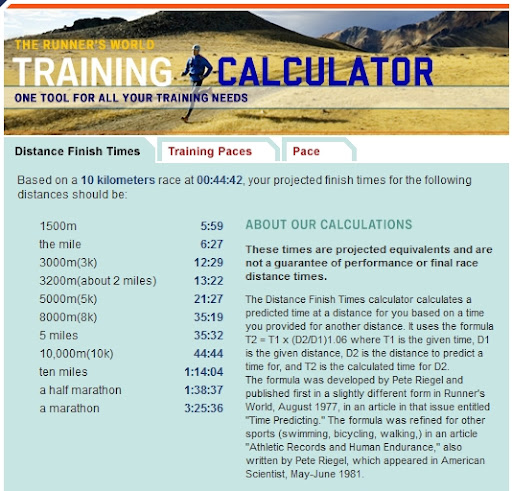
According to every pace chart and training calculator I've looked at, a 7:12 10K pace should translate into a 7:28ish half marathon pace (which is what I'm shooting for in November) and a 7:51-2ish marathon pace. If I'd run that 10K all-out I probably would've been closer to 7:09-10 / mile, which translates into a 7:48 marathon pace.

I am greatly disturbed by this.

I know that part of the reason is because I'm just not trained for the distance yet, physically or mentally. You know how for toddlers a five-minute time-out is just as bad as a fifteen-minute time-out, and how birds can't tell the difference between six and twenty? Well, as far as my brain is concerned, 26 miles might as well be 100 miles. It's just a really long-ass way.

Allow me to express how I feel about 26 miles as a distance in the form of a short one-act play:
Vaguely interested party: "Oh, you're running a race? How nice! How long?"
Me: "Really effing long. That's how long."
VIP: "Oh, but in miles, dear?"
Me: "Like, a billion, maybe? I don't know. Approximately one metric f***-ton. A lot."


(fin)

So, yeah. I can imagine running 7:50 miles for a finite distance, but somehow 26 seems kind of...you know...not finite. Like I'll just be running, indefinitely, until someone takes pity on me and lets me stop. Or I die. Whichever.

Pace charts & calculators aside, I find that I deal better with this situation mentally if I just think of my marathon pace as "under 8:00 / mile." Hell, it's my first marathon; I've got nothing to prove. All I have to do is manage not to get lost, stop breathing, or lose the ability to put one foot in front of the other. On my first marathon pace run last Thursday, that's really all I was shooting for -- run six miles in under 48 minutes. The run went okay, although considering that I was running uphill most of the way and in the heat, 7:52 / mile was probably too fast. (It definitely felt harder than I thought it should; my heart rate averaged 179 bpm, or about 80% max.)

Yesterday was my second, seven miles this time. I did it on the track, so although it was flat, I did have to contend with that wicked headwind on the backstretch. It was particularly bad yesterday, too -- most of the time, I would come around the turn and feel as if I had actually stopped moving. Sometimes I could barely keep my eyes open. I hit every lap in almost exactly 2:02, for an average pace of 8:08 / mile. Not sub-eight, but I'm willing to chock up *at least* eight seconds per mile to the wind

Mentally this was a hard, HARD run. Now, let's not forget that I ran my last 10K at a 7:12 pace and thought that seemed too easy. It seems ridiculous that I'd be running 8:08 miles and worry after two that I wasn't going to be able to keep up the pace. Nevertheless, that's exactly how I felt. Physically, everything was going fine -- I was keeping an almost creepily steady pace, wasn't hurting anywhere, and my heart rate stayed right around 78% of max. Physiologically, it was all systems go. Mentally I was grasping at anything I could to get me through the next mile, the next lap, the next step.

I finished (not even breathing hard, of course, because no one breathes hard at 78% of max) and thought to myself, 3.75 times? I have to do that 3.75 times IN A ROW???

This was the first glimpse I had of what the Hanson brothers are talking about -- cumulative fatigue, and learning to run at your goal pace no matter how shitty you feel.

I still don't know if I buy 7:50 as my marathon pace. I'm willing to work with "under 8:00" for now & see where it takes me. The real test will come in Clarksburg; I'll feel a lot more comfortable with what pace charts & calculators are telling me once I have a current half marathon time to plug in. If indeed I can pull off a 1:38ish half and the marathon training is still going well, then I'll feel comfortable shooting for 7:50-55.

Still, honestly...I'm so much more excited about this than I thought I would be. I hope I like it. :)

Wednesday, September 7, 2011

Committed.

I have a confession to make.

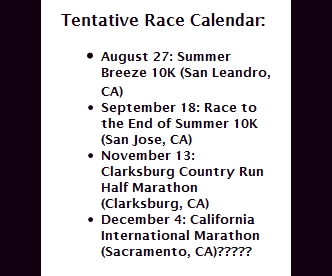
If you're super-observant, you may have noticed that for sometime part of the sidebar over there looked like this:

cim???

If you'll glance over, you may notice a distinct change (aside from ticking off races).

So....yeah:


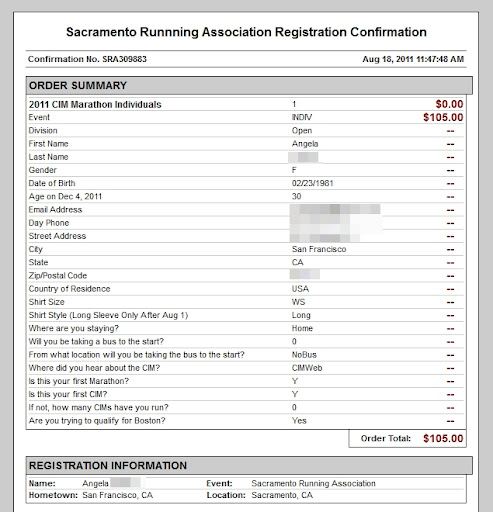
Holy balls, Batman.

~*~*~*~*~*~*~*~*~*~*~*~*~*~*~*~*~*~*~*~*~*~*~*~*~*~*~*~*~*~*~*~*~*~*~*~*

First, let's get a few things out of the way about the confirmation page:

  • Are you really staying at home and driving an hour and a half to Sacramento on race morning?
    Hells no; I'm going the day before to stay in a hotel like a normal person. I wasn't really thinking all that clearly when I was registering, though, so the hotel question kind of caught me off guard. Since I hadn't even thought about where I'd be staying, I just put "home" because "I am kind of too freaked out by the idea that I'm actually doing this to think about things like hotels" was not an option. (I did briefly consider driving up race morning to save money, but between packet pickup, dealing with parking, and losing two hours of sleep, it seemed worth the cost of a cheap motel.)
  • Are you really planning to cab / hitchhike / jog / Marty McFly it to the start?
    Again, no; I'm taking the bus like a normal person. (That whole "I am too freaked out by the fact that I'm actually doing this to think about things like how I'm getting to the start" thing again. I also often have a knee-jerk reaction to things that cost extra money. Thankfully I checked and you can buy a bus ticket at the expo if you didn't get one when you registered.)
  • Are you really trying to qualify for Boston?
    Given that it's my first marathon, it's not my top priority, but based on my times at other distances, it seems reasonable likely enough that I could do it that I figured I wouldn't embarrass myself by checking yes. Mainly I am trying to run the fastest marathon I can, and if it happens, it happens. (Also, checking yes didn't cost extra money.) (That was a joke about my cheapness.)
  • But I thought you were anti-marathon!
    I'm not anti-marathon but it's true that I did say for a long time that I would probably never run one. Why I decided to do it is a bigger question that I'll have to tackle in a separate post -- it's going to take me a little time to get my thoughts together and be articulate about this business.

Until then, who else is running CIM? Wanna carpool or meet up at the expo? :)

Monday, September 5, 2011

Week In Review: Aug 28 - Sept 4

Running ShoesThis is my weekly training journal. Including it in the blog gives me a little extra accountability in the mileage department & helps me stick to my schedule. :)

10 Weeks to Clarksburg Half Marathon!!

Last Saturday, I ran my last 10K for the year (Summer Breeze in San Leandro). Now, it's back to half marathon training -- ten weeks to Clarksburg Half Marathon on November 13!

Monday: 4 miles easy. Kind of warm out and I also ran the hilly route, so I probably should've taken it slightly slower, but still a good, short recovery run.

Tuesday: 6.5 miles (2 wu + 6 x 800 @ 10K pace with 400 recoveries) 3.5 miles (2 wu + 2 x 800 @ 10K pace with 400 recoveries) Ugh. This sucked, for lots of reasons. Mostly I'm blaming it on a combination of not being fully recovered from Saturday and bad luck. I decided to walk away after two somewhat questionable intervals, which I think was the smarter choice.

Thursday: 7 miles (1 wu + 6 @ 7:52 / mile) Not what I'd call a pleasant run (heat*, hills, wind, asthma), but I got it done, chest pain- & stomach cramp-free, no less. The goal pace for this run was 7:50-7:55, but considering everything I was up against, part of me wonders if the right effort level might have been more like 8:00 / mile and that averaging 7:52 actually means I was running harder than I should've been. Still, I averaged 179 bpm, which is about 80% mhr for me (ie, supposedly I wasn't all that running that hard). Somehow it felt harder than that.

*Y'all know that when I say "heat," I mean relative to SF, right? Meaning it was like 70°? Just checking.

Friday: 5 miles easy. I've been trying to go back to running hilly routes on my easy days; unfortunately, that makes it a little tougher to make sure I'm running at the right intensity. The target pace for this run was 8:50-8:55 and I averaged 8:52, but again, considering hills, wind (grrrr...), & heat, I kind of wonder if I should be shooting for 9:00-9:05ish instead. (Sounds like a job for the heart rate monitor...)

Saturday: 12 miles easy. Originally, this was supposed to be a tempo run day, & the long run was supposed to be Sunday, but due to all kinds of frustrating crazy that's not worth going into, that plan became non-implementable. Feeling kind of pissed, I ruminated over what to do for a while, then finally decided to just do the long run today because I had the time and didn't have to drive anywhere to do it. The first six miles were kind of insanely rough on my shin splints, but strangely the pain mostly disappeared during the second six. In general, it was a good run, though, and I did a good job of keeping it at an easy pace. (Again, shooting for 8:50-8:55 / mile & ended up running 9:01 / mile, which, considering that I ran basically the first half into a stiff headwind and also had to contend with a few hills, was probably about right. I did wear the heart rate monitor this time & averaged 164 bpm, so that's a good yard stick for what I should be doing on these easy runs in terms of effort.) And, bonus for everyone, I came back in a MUCH better mood than when I left. :)

Grand Total: 31.5 miles

Not bad, for a post-race week (was that only last weekend??? Geez, this has been a long week...). I was hoping to get Saturday's originally scheduled tempo run in on Sunday (since I did the long run scheduled for Sunday on Saturday), but my shins were REALLY sore after the long run (still having those obscenely painful stabbing pains in places), so, as much as I'm itching to start putting in 40 mile weeks, I decided the best thing was to stay off my feet today and rest. After all, I'm in pretty decent half marathon shape already (thanks to the 10K Summer Tour), and still have 10 weeks to go. :)

Friday, September 2, 2011

Obscure Local Races: Clarksburg Country Run

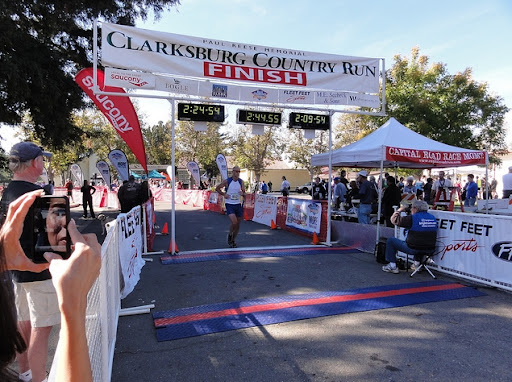
Clarksburg Country RunYou know how your conversations about running tend to go, even if the other participants aren't necessarily runners. Eventually someone asks you if you're training for something. For me these conversations have gone kind of like...

"Oh, so are you training for anything?"
"Yeah, I've got a (few) 10K(s) coming up, then a half marathon in November."
"Oh! Nike Women's! ZOMG so awesome & empowering!"
"Um--no, I'm not running Nike--"
"Oh, Big Sur Half? I hear that's like the most beautiful race ever ever EVER!"
"Um--no--"
"Ah, the US Half, then--that's supposed to be pretty cool too."
"No--"
"Santa Barbara International?"
"Nope."
"Malibu International?"
"Nope."
"Run With The Jets?"
"Nope."
...
"So...what race are you running?"
"Oh, it's the Clarksburg Country Run. In Clarksburg."
...
"What's a Clarksburg?"

Heh. Mostly, I just find it amusing. I actually spent many, many weeks agonizing over which fall half I was going to do; you can read all about my hand-wringing in this post if you want the full story.

If not, I'll recap for you:

  • I don't mind running hills at all, but my big goal for this particular half is to break 100 minutes and qualify for the Prestige Half Marathon next year, so I need a flat course. That nixes the US Half & Big Sur.
  • Similarly, I am terrible at windy courses (as in having many turns) and it's very hard for me to run tangents without memorizing the course (which I suck at), so Primo's Run is out.
  • I'm still only working as a part-time contractor, so I don't have a bunch of extra $$$ to throw around. To be honest, unless it's a really special event for some reason, I have a hard time justifying more than about $60 for a half marathon, mostly because so much of the time all that extra money goes to stuff I can do without (giant medals, photography companies, rock bands & after-parties I won't attend, etc.). That nixes a BUNCH of stuff -- R&R San Jose ($85), Healdsburg Wine Country ($95), & Nike Women's ($130!!?!? Are you KIDDING me? Jesus effing Christ) to name a few. Anything where a hotel is involved is also out of the question.
  • I always prefer a small, quiet, more personalized race to a big, flashy, crowded one; it helps me relax and keep calm, which usually leads to a better race.

So after a bit of hemming & hawing, I settled on this tiny, cheap, flat little half an hour or so away that looked like it might be a little more competitive. It seems unlikely that I will share in the $29,000 prize pot (hah), but at least there will be plenty of parking and a free lunch in the school cafeteria afterwards, and showers if I'm feeling too gross for the drive home.

So here's my sort of "pre-race report":

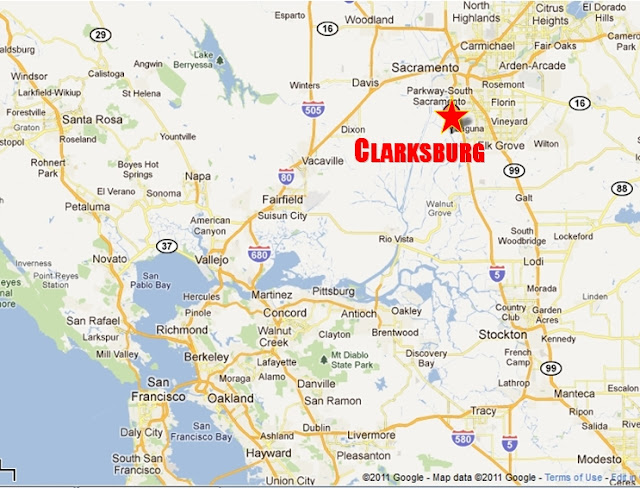
Location: Clarksburg, CA (close to Sacramento)
Date: Mid-November (November 13, 2011 this year)
The Deal: The event is a fundraiser put on by several Clarksburg community groups (Boy Scouts, Fire Fighters, Cub Scouts, The Soccer Club, & Clarksburg Schools) who volunteer to run it. Also, Clarksburg is a PA USATF Championship race, which is kind of exciting.
Price: There are several different events:

  • 20 Mile or Half Marathon - $45.00 til 10/28, $50.00 til 11/12, $55.00 race day
  • Half Marathon Relay (2 people) - $70.00 til 10/28, $75.00 til 11/12, $80.00 race day (per pair)
  • 5K or 10K - $30.00 til 10/28, $35.00 til 11/12, $40.00 race day
  • Kids' Fun Run - $10.00 til 10/28, $15.00 til 11/12, $20.00 race day

Deadline: Race day registration
Field Size: In 2010, there were 601 participants in the half, & 53 in my age group. (You may be thinking that in a field so small, my chances of placing may actually amount to something! Heh, no. That's the magic of a PA USATF Championship race. Lots of super-speedy runners will be there to earn grand prix points; if I have a good race, I can probably make it into the top ten in my age group, but that's really all I can expect.)
Sellout Factor: Unlikely, as far as I can tell; PA USATF grand prix aside, it's a small local race. In the FAQ section, the response to "Will there be race day registration?" is "You bet!"

The Course

To quote the site, "All courses are USATF certified, flat, paved and scenic past area wineries and farms." Certified, flat, paved -- them's the magic words. :)

It is a little bit of a drive, but given the small size of the race, ease of parking, race-morning packet pickup, and 9:15 start time, making the trip up from SF that morning seems a lot more reasonable than it might be otherwise.

So there you go -- your obscure local race education for the week. :)