Showing posts with label articles. Show all posts

Thursday, December 21, 2017

The deal with those fancy new Nike shoes.

ICYMI the ever-inquisitive Alex Hutchinson has left Competitor (RIP Competitor, which is *kind of* still Competitor but not really) and now writing for Outside Online. Most recently he tackled the issue of those fancy new Nike shoes, the Vaporfly, which purportedly improve efficiency by 4%. Now, for a while that was just Nike making claims, though the lack of actual scientific evidence did not stop many people from rushing out to drop hundreds (!) of dollars on them. But last week the results of an actual, rigorous randomized control trial run by a legit, reputable lab (the University of Colorado’s Locomotion Laboratory) were published in a for-real peer reviewed science journal (Sports Medicine), and it's official; the Vaporfly really does (or at least can) honestly and truly improve runners' efficiency by over 4%.

Yes, the study was funded by Nike because that's how research works, but given the reputation of the lab and the researchers involved and how the paper was published, you can be reasonably sure that the results are legit and not just more Nike propaganda. So, yeah, if someone is wearing them and seems to have an astonishingly good race, there is a nonzero change that the shoe really did have something to do with it. (As you probably already know, Eliud Kipchoge was wearing them when he clocked that just-barely-not a 2 hour marathon in Italy earlier this year, and Shalane Flanagan was wearing them when she destroyed the NYC marathon last month; see also Galen Rupp in Chicago and Camille Herron destroying the 100 mile record by over an hour.) To quote Hutchinson, "There’s something going on with these shoes."

Monday, May 25, 2015

SRM WEEK 7 OF 20: Another piece in the puzzle of my busted right leg.

Can I just say, this man is kind of my hero.
If you've been reading for a while now, you've probably heard me rant/complain at some point about the chronic problems I have with my upper right leg. It started a little over two years ago, when I was about 6 weeks out from Mountains 2 Beach Marathon, as adductor pain & tightness, which then moved around to my quad, and then during the race itself I actually ended up tearing a muscle in my quad & being on crutches for a month. SUPER FUN.

It's never quite been that bad since, but I also haven't really been able to train solidly for anything since then. It'll be totally fine for a while, then pop up out of nowhere & require anywhere from a few days to a week off, and it seems to be particularly aggravated by fast running (whether speed work or trying to race). And the really strange thing to me has always been how it's not particularly localized: it might be my hip flexor one day, my hamstring the next, or my adductor, or my quads.

Regular massages help a lot with the symptoms, but it's always been incredibly frustrating to me that after 11 months in PT, all kinds of medical imaging, and hundreds of dollars' worth of gait analysis, no one has ever been able to tell me what the actual problem is or how to get rid of it permanently. Recently, though, I feel like I *may* have stumbled onto a potential clue. I'm wary of getting too excited about it, because I've felt like I was on the verge of an answer too many times before, but this time a lot of the pieces certainly do seem to fit.

So! Let's talk internet reading (which I see you are into).

I know I can't be the only person who constantly clicks on interesting links as I peruse social media & think to myself, "I'll just keep that open in a tab to read when I magically find myself with oodles of extra time get around to it." And then one day I open my computer to find forty tabs open staring forlornly at me, with even odds as to whether I just give a little shriek of terror & immediately close them all.

For the last couple of weeks, I've had a tab open to an article from IRunFar.com called Elite Feet: Strong Strides Start At The Foot, by ultra-runner/coach/PT Joe Uhan. The reason I clicked on it initially is because it was posted by A.T., the woman I've been doing strength training with once a month or so, with a note about how in her circle of runner-oriented PTs/trainers/coaches/etc., foot mechanics had been a hot topic lately. Basically it sounds like the tendency is to ignore feet unless there's actually an acute problem like plantar fasciitis/collapsed arches/etc., when in fact foot mechanics can have all kinds of effects (including injuries) up & down the body.

Last weekend I was getting fed up with the number of tabs open in my browser & finally decided to slog through this & a bunch of others so I could finally close them. The main topic was foot strength & stability, particularly in the crucial arch/inner toes/ball of foot area.

    "While our feet are designed for many motions and actions, with locomotion–-walking and running-–the most powerful and important power-generating structure is the medial arch. As such, I call it, ‘The Power Ray.’ Through this structure is where we should do all our weightbearing, footstrike, and push-off in both walking and running. [The rest of the foot] is designed more for balance and for cushioning at initial contact. Normal gait involves initially contacting on the outside, then quickly transitioning to The Power Ray engagement."

I found the foot stuff interesting enough, because not rolling through onto my arch is a problem I had pretty severely on both sides for a long time. (Probably because prior to that I had some really bad medial shin splints & dramatically "under-pronating" was the only way I could get any relief.)

The next part got into how engaging "The Power Ray" correctly is what lets us load up our most powerful running muscles effectively:

    "When the foot is loaded through The Power Ray...this action creates an automatic, full-blast activation of the gluteal muscles: both the gluteus medius–-the main leg and pelvic stabilizer–-as well as the gluteus maximus, the most powerful muscle in our body. Proper foot and leg alignment allows ground-reaction force to flow up the leg through the activated hip muscles, creating a powerful, effortless, and automatic push-off."

Sounds kind of important, right?

Then he got into the consequences of not loading up The Power Ray correctly. Of course, most of us are familiar with the whole arch/leg/knee collapsing inward situation (usually referred to by the catch-all term "over-pronation") that tends to cause all kinds of yucky hip/knee/IT band overuse issues.

What caught my attention, though, was his discussion of the opposite problem:

    "The converse condition is where the runner lands only on the outside of the foot. They ram down on the lateral aspect of the foot, avoiding The Power Ray entirely, either by conscious ‘fear of pronation’ or unconscious instability avoidance. In this strategy, runners over-use the lateral foot, as if the brain doesn’t trust the medial arch (or, if for some reason the arch is sore, weak, or unstable). While they might be avoiding collapse stress, the consequence is the same: the foot and lower leg are improperly aligned, and the hip muscles fail to activate."

While it's nowhere NEAR as bad now as it's been in the past, that was still sounding uncomfortably familiar.

And then, discussion of the most common compensatory injuries:

    "If the leg is not pushing off as powerfully as the other side, the opposite leg has to over-reach in order to make up the deficit. This is the primary cause of landing-stress injuries, such plantar foot pain, shin pain, IT-band pain, and many others...If the hip muscles are not fully activated, the other leg muscles have to take up the slack. If that lightning bolt cannot travel up to the hips, then the lower leg muscles–-the quads, hamstrings, and calves-–do the bulk of the propulsion."

This is where my brain really started to sit up & take notice.

    "Very often, runners and sports-medicine professionals alike tend to hyper-focus on the symptomatic landing leg. They will focus their treatment on stretching, massaging, or strengthening the [problematic] leg and hip in order to prevent the collapse."

Check, check, and check. During my many many months of PT, my right knee was constantly collapsing inward, yet I was passing all the hip & core strength tests with flying colors, and no one could figure out how that made any sense.

    "But whose fault is it, really? It’s the [opposite] foot, for pushing the trunk too far [in the other direction]! The linchpin to the issue is the [asymptomatic] leg strength and stability. Conversely, any efforts to shore up the [symptomatic] leg usually result in only temporary relief."

Which reminded me of what A.T. had said the first time she watched video of me running and then watched me do squats--that I clearly had some kind of strength imbalance/asymmetry, but if the problem was my right leg (the one where I tore the muscle & that has continued to grumble at me on & off in the ensuing two years), then all my symptoms were backwards. (When I run & do squats, it's my left hip that drops; if the right leg is weaker, then the right hip should drop.) Her theory has always been that for some reason it's my left glute/hip/whatever that's weaker, and the problems in my right leg came from overcompensating.

The one problem with that theory was that in all the strength testing I've had off my feet in the last couple of years, neither side has ever seemed particularly weaker than the other.

So, what if the problem is on the left side, but instead of glute weakness, it's actually glutes not activating properly because of what my left foot is doing?

Uhan then went on to describe an informal experiment that he tried in his practice, involving 10 patients with ongoing leg pain in one side, who had also had a previous foot and ankle injury on the other side:

    "I video-recorded the side view of each trial. No running cues were given, nor were they given any information as to why I was taping his or her foot. Hip-extension angles-–the range of motion measure correlated to push-off power–-were measured. For each subject, I conducted three running trials:
    • A pre-test running trial. I tested each runner at a comfortable speed, wearing their preferred shoes.
    • A supported-foot running trial. For each runner, I then kinesio-taped the previously injured foot, such that the medial arch was maximally supported and facilitated to engage The Power Ray. They ran at the same speed.
    • A post-test running trial. The tape was removed, and they once again ran at the same speed.

    The results: in nearly every subject, hip-extension range of motion improved by 10% with supportive foot taping. This effect disappeared when they were re-recorded, without foot support. Both the runners and I were shocked at the automatic improvement in hip extension push-off when the foot was placed in a supported, optimal-loading position. What I concluded was that simply getting The Power Ray to engage the ground was enough to improve hip activation and push-off."

And if the problem is that the symptomatic leg has been over-compensating for the other leg's lack of hip extension all this time (because of what the foot was doing), then that should solve the problem.

For the last 6-8 weeks or so, I've had more pain & tightness in my upper right leg than usual, and even though I wasn't truly racing in either case, it was definitely worse after both Parkway Half & Bay To Breakers (I'm sure because I still ran both of them significantly harder than my typical "easy" pace). I could rest it or take it easy for a few days & the pain would subside a little, but as soon as I went back to my normal amount of running, it always came back to some extent.

Case in point: This week.

~*~*~SRM WEEK 7 OF 20~*~*~

Grand Total: 32.5 miles

    * 18.5 easy
    * 14 long
    * 2 x 45:00 strength

Monday: a.m. roll/stretch/strength; p.m. karate.

    My epic 17-mile Bay To Breakers Sunday was great fun, but also kind of wrecked me for the rest of the day. When I got up Monday morning to head to the gym, I definitely had that tight, worn out feeling in my legs the next day that let me know that I had probably done some combination of too much/too fast/too soon. In particular, my right quad & adductor were #notamused. So instead of 45 minutes of strength I did more like 25 minutes of stretch & roll alllllll the things (especially the right leg) + 20 minutes of non-leg strength stuff.

Tuesday: 2.5 easy.

    Prior to Tuesday, I had been thinking, "FINALLY! This week, I will start my four weeks of baby-steps intro-to-speed." Hahahaha no. Barely a mile into this run, I felt like I'd run ten, plus my right leg (quads this time) was waving the big fat NOPE banner. So, instead of an 8 mile progression run, I spent like an hour aggressively rolling every muscle in my right leg while watching The Daily Show.

Wednesday: Karate.

    I meant to get up & do real actual strength work but instead I decided I needed to sleep some more. Before karate = another hour of aggressively rolling every muscle in my right thigh PLUS all the glute/hip muscles (which were feeling tight & unhappy).

Thursday: 8 easy.

    This run actually would have been awesome, except for the near-constant aching in my right quad. Though to be fair I actually also kind of suspect that I may have rolled my quads a little too aggressively & so at that point they were just kind of bruised & beat up. Still - 7 miles including 12-15 fartleks 1:00/1:00?

Friday: 8 easy.

    GOD. The right leg. I was so frustrated at this point. Basically it seemed like, ok, sure, I can run a hard workout or a semi- (not actually) hard race every once in a while and maybe my leg won't self-destruct if I then take like 3 rest days and roll the heck out of it, but that's not exactly what you call ideal training for a PR marathon. It felt better than it had Monday, but still, things were unhappy, in that way where you can tell they're maybe kind of threatening to do more than just be mildly unhappy.

Saturday: Rest. And to be honest, at that point it hurt bad enough that I was considering just skipping my long run on Sunday so that maybe my leg would fully recover & I'd be able to get a solid week in next week.

But. Then I read this article.

Now, I had no kinesio tape, and wouldn't know how to tape my foot in the way he described even if I did. But I do know that I tend to avoid bearing my weight fully on my left arch (my foot gets sore when I do), so I thought maybe I would try a few miles Sunday anyway, making a conscious effort to run on "The Power Ray" and not the outside/middle of my left foot as I normally tend to.

Sunday: 14 long

This wasn't easy, but WOW. Even in just the first few miles, I could feel a) my left foot getting sore and b) the glutes on my left side engaging almost without any extra effort on my part. At the same level of effort as usual (aside from thinking about my left foot), my pace dropped by 30-45 seconds per mile. And?

No pain in my right leg.

None. Not even a little.

Originally I had thought I wouldn't push it more than 10 miles, but everything felt so good that I decided to go to 14. I kept waiting afterward for the stiff, achey soreness I've been inevitably dealing with in my right leg after only 6-8 miles, but again, it just never happened. In spite of running close to double the distance I had earlier that week, my leg felt completely normal.

All I'm saying is, there may have been some celebrating.

Uhan again:

    "Efficient push-off–both power and direction–begins at the foot. Simply put, optimal foot and lower-leg alignment is loading The Power Ray, with the foot straight ahead, rolling through a strong arch, and pushing the foot straight behind. 'Elite Feet' is the term for this action, as elite runners do this flawlessly:
    • Loading the ball of the foot and big toe,
    • Rolling straight through, and
    • Pushing the foot straight behind.

    It’s that simple. But to do so successfully and consistently requires focus, and a great deal of strength development of both the foot and the lower leg.

So, if indeed this has been my problem all along, I probably do need to actually do something about my left foot so that I don't just end up with a busted arch.

What To Do?

Uhan has three main suggestions for strengthening/stabilizing feet & arches.

1) Heel Raises. Like standard calf raises, but bending your knee a little so that the "Power Ray" is doing the work. (More details on exactly how to do this correctly in the article.) He suggests working up to 50 on each leg and 100 on both legs together. This seems like a pretty easy one to throw into my usual routine.

2) Ankling Drills. Apparently you can find lots of examples of these on YouTube. This one is new to me, but it looks like it would fit right in with the skips/bounding/etc. I do before track workouts. (Y'know, back when I did track workouts...)

3) Squats/Other Single-Leg Exercises/Drills. Basically do whatever it is normally, except pay close attention to what your feet are doing. Lunges/step-ups/step-downs/squats/monster walks/etc. will all work; just be sure that with every step or use of your leg, you're rolling through to bear your weight on the arch (while keeping the knee aligned above the 3rd toe, more or less). I do a bunch of this stuff anyway; I should just start paying close attention to my left foot to make sure I'm using my arch correctly.

So...yeah. For now, I'm cautiously optimistic. We'll see what my baby-intro-speed sessions bring.

Wednesday, March 7, 2012

How To Run A Great Half-Marathon

Just kidding. I doubt I know any more about running a great half marathon than you do.

Which is kind of cool because it means I don't put a ton of pressure on myself about it. I think there are people out there who are fast enough & fit enough that it's really, really important for them to find just the right training program, do just the right speed workouts, tempo runs at just the right pace, etc. etc., or they won't improve.

I am (obviously) not one of those people. (I can tell because there is no one paying for my running shoes who is not related to me.) Where I'm at, I figure that if I'm a) running consistent mileage, b) doing some kind of speed work, c) doing some kind of tempo work, d) running at least 12+ miles a few times a month, I am all good, and the bulk of my progress is going to come from increasing mileage & pace when I can. (Oh and also not taking giant chunks of time off due to bad injuries or feeling smug about marathon cycles).

The COOL part of that is that I don't actually believe that what specific training plan I use (or, let's face it, fabricate whole cloth) actually makes a difference as long as all the elements mentioned above are involved. I have no training plan loyalty. In fact, I actually really enjoy hunting down different ones & trying them out just to see how they work out for me, and several times that's how I've discovered new workouts that I've come to love.

For each distance I've raced, I have a folder of bookmarked web pages. Some indeterminate amount of time ago, I found and bookmarked this one on half marathon training, which I found really interesting & informative. (It's particularly relevant, given all the recent lab testing.) I'd never actually tried following the program it outlines, but I stumbled onto it again back in January when I was trying to make decisions about how to prepare for Oakland, and figured why the hell not.

So here's the plan. Note that it only includes the "quality" workouts -- these guys figure you know to intersperse them with easy runs that put your mileage where you want it.

(PHMP = planned half marathon pace & LTRV = lactate threshold running velocity, btw)

WEEK 1

  • Toughie No. 1: Three 10-minute intervals at 10-K pace, with 5- minute recoveries
  • Toughie No. 2: Three miles at PHMP
  • Toughie No. 3: A 5-K race or time trial

WEEK 2

  • Toughie No. 1: Four 6-minute intervals at 10-K pace, with 1- to 2-minute recoveries
  • Toughie No. 2: Four miles at PHMP

WEEK 3

  • Toughie No. 1: 3.5 continuous miles at LTRV (10 to 12 seconds per mile slower than your current 10-K PB)
  • Toughie No. 2: Repeat 800s at a pace which is 6 seconds per 800 faster than current 5-K pace
  • Toughie No. 3: Six miles at PHMP

WEEK 4

  • Toughie No. 1: 10-K fartlek session (alternate 2- to 3-minute bursts at 10-K speed with one minute or so of easy jogging over a 10-K distance)
  • Toughie No. 2: Seven miles at PHMP

WEEK 5

  • Toughie No. 1: Moderate hill session (on a tough, steep hill, do six or more repeats, but not enough repetitions to induce soreness)
  • Toughie No. 2: Three 10-minute intervals at 10-K pace, with 5-minute recoveries
  • Toughie No. 3: 5-K race or time trial

WEEK 6

  • Toughie No. 1: Nine miles at PHMP (early in the week)
  • Toughie No. 2: 5-minute intervals at 5-K pace, with 3- to 5-minute recoveries. Leave the workout feeling fresh and charged-up, not mentally and physically drained.

WEEK 7

  • Taper properly during the seventh week by trimming mileage by 65 to 70 per cent. Focus on short, fast, but non-soreness-inducing sessions (repeat 400s at 10-K pace). To run a great half-marathon on Sunday at the end of this taper week, complete six 10-K paced 400s on Monday, do a three-mile PHMP effort on Wednesday, and run three 400s on Friday.

I haven't followed it to the letter, but I've been trying to more or less hit the high points as much as I can. (The main difficulty for me is that I am still not *really* back in HM shape, so running for 6-7 miles at that pace isn't really happening yet. I'm more doing interval HM pace runs like 3 x 2 miles or whatever.)

So here's the thing about using a new training program you're not used to -- There are all these WEIRD ASS workouts you're not used to! Like 10K fartlek bursts. Who does that??? (I mean, other than Beth, *obvs*.)

(But seriously. It took me like 3 days to work up the guts to try the fartlek session. I was. Not. Into it.)

I'm an adventurous eater, but I think that when it comes to running I have to admit that I'm the equivalent of that one guy you know who's past 30 and still only wants to eat pizza and mac & cheese for dinner every freaking night. I want to do what is familiar and comforting. I understand 5 minute repeats at 5K pace. They get me.

This week, the new & frightening thing on the schedule has been this "moderate hill session" from week 5. I mean, it's not like it's logistically hard. I live at the bottom of like 5 "tough, steep" hills. Even going uphill, 8-10 repeats can only take so long. So why do I feel like hill repeats is some awkward, unattractive dude that keeps asking me out, and I keep being like, "Ummmm, I'd LOOOOOOVE to, but I'm SUUUUUPER busy washing my CDs & rewinding my cats"?

As we say in karate, I must study this deeply.

Monday, August 15, 2011

A Few Myths About Orthotics

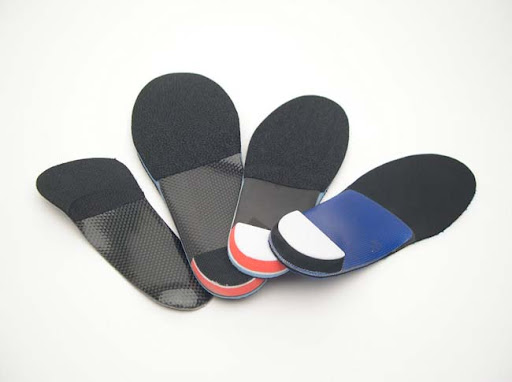
orthoticsDue to mild pronation, I've run in a stability shoe for as long as I've been getting my shoes professionally fitted. That was towards the beginning of college; before that I honestly can't say what type of shoe I was running in, because my basic approach was to try on a bunch of running shoes until I found ones that felt comfortable. Then there was the one year we couldn't afford shoes and my coach gave me a pair to wear for the season, which I think were actually used and already worn out. Given all that, it's probably not surprising that I suffered from horrendous shin splints for years that all manner of leg and foot exercises did nothing to fix. Around the same time that I started wearing a stability shoe, I also started trying to switch to a forefoot strike; between these two things, my shin splints all but disappeared in a few months.

Earlier this year, I got really curious about racing flats and started looking into getting a pair for shorter races. At the time, flats weren't something I knew much about. In high school I wore spikes for time trials and races 1600 m or shorter or regular trainers for workouts and two mile races; it never occurred to me that there was any other option. (Mostly I wanted them for 5Ks & 10Ks - it's hard for me to imagine running farther than that with that little cushioning.) In an effort not to walk into a running store completely clueless on the topic, I tried to at least do some research on how flats are fitted compared to trainers and what different types exist. Alas, there wasn't as much detailed information out there (at least that I was able to find) as I'd hoped. So, armed with precious little knowledge beyond the basics, I put myself in the hands of the shoe people at Roadrunner Sports.

And I learned a few things right away. First, that there are two types of racing flats: performance neutral or "true" flats (very little in the way of cushion and support), and performance stability shoes (slightly more support, mostly aimed at preventing overpronation). After video-taping a few seconds of me running barefoot, they confirmed what I already knew: high arches + flexible ankles = not insignificant overpronation. Which, one of the salespeople explained to me, meant that running in a true racing flat was probably out of the question.

On the off chance that it might help, they did a quick custom orthotic for me and we did a few more videos of me running in the neutrals with the orthotics. It made some difference, but not really enough. Next, we tried a few different performance stability shoes. In those videos, my pronation looked similar to when I was wearing the neutrals with orthotics. When we added the orthotics to the stability shoes, the pronation was almost gone. So I left that day with my Mizuno Musha Wave 3's and a pair of molded inserts.

In the last couple of months before this, the shin splints I thought I had banished back in college had been sneaking back up on me. They weren't as bad as they had been; just noticeable enough to be annoying (and worry me a little). On the off chance that it might do some good, I started switching the molded inserts into my trainers when I wore them. (It didn't.) As I've mentioned lately, I think they've been getting better in the last few weeks; I'm now running in my new Brooks and the molded inserts in an effort to add every little bit of stability I can.

It's been a while since I discussed all this with someone with an actual medical degree, though, so recently, I made an appointment with a sports medicine podiatrist, just to see what he thinks. Then today, I ran across another Gina Kolata article regarding orthotics and running.

That was kind of a bummer.

Well; sort of. It turns out that yes, orthotics really do work in a lot of cases in that they often do let people run or walk more or less pain-free when they weren't able to before. On the other hand, there's apparently a lot of bad information out there about orthotics as well. The article goes into a lot of detail, but here's what I took away from it in terms of myth-busting:

Myth#1: Doctors understand how orthotics work. Apparently they don't, really. It's more a process of trial and error than anything else.

Myth #2: Doctors can predict what effect a given orthotic will have on a given patient's biomechanics. Unfortunately, ten patients with the same biomechanical problem may react to the same orthotic in ten different ways. Depending on how a certain patient responds, the issue may get better, worse, or stay the same.

Myth #3: Orthotics change a person's running form & kinematics (how the skeleton moves during running). Even when a patient reports that orthotics are working, there is rarely evidence that s/he is actually moving differently as a result of the orthotics. (On the other hand, there is evidence that wearing orthotics can reduce muscle strength.)

Myth #4: There is good scientific / medical evidence that orthotics prevent injury. There isn't. There are lots of studies, but most of them are not scientific or lack rigor. That doesn't mean that orthotics don't prevent injury in certain cases, just that there is no real evidence that they do. (The article does site one well-controlled scientific study where orthotics did appear to reduce injury in a group of soldiers; but again, even in the soldiers who suffered fewer injuries, the researchers did not see evidence that the orthotics changed anything about their biomechanics. Also, the soldiers chose their own orthotics based purely on what they thought was comfortable, without any input from a doctor at all.)

The article wraps up with some advice from a professor of biomechanics: Instead of turning to orthotics right away, he says, most athletes would do better to instead work on strengthening the muscles in the affected parts of their legs.

So really, who knows whether those custom inserts are really doing anything for me or not? I'll definitely be very interested to see what the podiatrist has to say about all this next week.

Tuesday, August 9, 2011

"Vitamin I"

IBI am a recovered Ibuprofen-aholic.

By and large, drugs have always seemed to affect me less than other people. To give you a sense of the scale we're talking about here, a couple of years ago, an outpatient procedure I was supposed to have couldn't be performed because eight times the normal amount of anesthesia failed to knock me out. Sleeping pills have never worked on me. Caffeine doesn't appear to have much effect either. Tripling the dosage of any cold or allergy medication is standard operating procedure, if things are bad enough that I even bother taking it.

When I was younger and suffering from debilitating menstrual cramps (not to mention routine soreness or the odd injury from running or gymnastics), I learned very quickly that taking things like Advil, Aleve, or Tylenol at the recommended doses was pretty much equivalent to eating candy for all the good it did. Even at higher doses, it was kind of six to one / half a dozen to the other whether any break in the pain that happened to occur was due to the drugs or would've happened on its own anyway. My doctor didn't want to prescribe anything stronger to a kid, so my mom would sometimes give me hydrocodone prescribed for her if it got really bad, just so that I could sleep / function / etc.

Though it didn't help with pain, I did still occasionally take Ibuprofen for its anti-inflammatory properties when I felt particularly sore or had a legitimate injury. When I was having a lot of knee pain several years back, my doctor prescribed 800 mg tablets of Ibuprofen. (Sidenote: This has never made any sense to me. OTC Advil tablets contain 200 mg of Ibuprofen and there is certainly no one stopping people from taking four of them at once. Plus, generic OTC Ibuprofen is usually cheaper per mg than the prescription stuff anyway.) When it didn't do much for the pain I started doubling it, which seemed to have at least some noticeable effect. (Not that I'm advocating this...Definitely DO NOT try this at home, kids.)

This kind of started a bad habit. If I was feeling sore from a run, I'd take 1600 mg of IB. Same thing if I was having weird pain I didn't understand. Sometimes I'd even take it before a run, under the impression that doing so would prevent inflammation and soreness afterward. My doctor happily refilled the prescription any time I asked. (Sure, I could've just taken the OTC stuff, but there was something a little unsettling about the idea of swallowing eight of the little red pills compared to just downing two of the big, white horse tablets. Upon reflection, I probably should have paid more attention to that unsettling thought.)

Then I started reading more about inflammation, pain, Ibuprofen, and how it works. Particularly, how it works in athletes, and how it works with regard to pain and inflammation that are not due to an acute injury.

First, the obvious:

1) Pain is how your body communicates with your brain. It informs us as to how our activities are affecting our bones, muscles, connective tissues, etc. Sometimes the message is, "Whew, that was a little tougher than we were used to! Maybe an easy day tomorrow." Sometimes it's, "Hey, we tweaked muscle/tendon/etc. xxx a little & need to rest it." Sometimes it's, "Seriously, bone/muscle/etc xxx isn't really strong enough for that right now. Back off." Shutting these messages off can be dangerous because it sometimes means we think we're stronger, healthier, or in better shape than we are, do too much, and wind up dealing with a more serious injury.

This is something I learned a lot about the first time I was in physical therapy. The way that PT put it: If the pain is not so bad you can't function, let yourself feel it, because what the pain does will be the best guide as to whether or not you should run, how much, how hard, etc. If it hurts so bad that you can't function without a pain killer, you shouldn't be running anyway. The time to turn that message off is when you already know you can't run due to an acute injury, and blunting the pain isn't going to tempt you to try.

Next, a few things that seem to be less well-known among runners (they were certainly unknown to me, up until a couple of years ago). This article does a pretty good job of explaining it all in more detail, but here are the 10-second summaries:

2) Taking painkillers before a workout doesn't prevent pain during or soreness after. When researchers poll endurance athletes at water stops during a race about how much pain they are experiencing and then over the next several hours and days about how much residual soreness they have, there is no difference between the responses of athletes who took painkillers and those who didn't.

3) Anti-inflammatories (like IB) can blunt the training effect. Training makes us stronger is because training is tissue damage, and our body responds to tissue damage with an inflammatory effect that helps muscles, bones, and connective tissues toughen up and become stronger. Anti-inflammatory drugs can inhibit that natural inflammatory response, essentially rendering your workout a waste of time. Kelly Starrett (DPT and awesome SF Crossfit coach) goes into more detail about this particular issue. (Love him, BTW.)

4) Anti-inflammatories (like IB) can actually INCREASE tissue inflammation when taken before or during a workout. Unlike the natural, beneficial inflammation that occurs after a workout that makes you stronger, chemically-induced inflammation can impair performance during a workout by adding to the stress that the body is already under.

5) Painkillers can impair kidney function when taken before a workout. Because kidneys are responsible for filtering waste out of the blood and regulating electrolyte balance, this can be a big deal during a hard workout or race (and the longer the event, the bigger the risk). If kidney function becomes poor enough, it can lead to hyponatremia, a situation where sodium levels in the blood drop below what is safe.

ice bathSo, you can maybe see why, at a certain point, I'd ask myself how badly I really need to be taking painkillers at all (barring, obviously, suffering some kind of heinous injury like breaking a leg or something). These days, I'm completely off of them -- I don't even take them for headaches. Instead, I've really taken K-Starr's advice to heart -- the best (and most side-effect free) strategies for managing routine soreness and mild tweaks are proper nutrition & hydration, ice (I mean really -- who DOESN'T love a good ice bath!?), stretching, massage, etc. I think it's a little easier for me because it takes so much of anything to have an effect anyway, but I also think that it's wise to treat drugs as the last line of defense whenever we can, rather than the first.

Thursday, July 21, 2011

Article: More Things We Think We Know

running on grassGina Kolata is fast becoming my go-to girl for busting all the best-loved myths of running lore. A few weeks ago, she wrote a column calling the 10% rule into question (the upshot: we have no scientific evidence that it prevents injury; we as runners have just been repeating it back to one another for so long that we assume it must have some credible origin somewhere). A couple of days ago, she wrote about running surfaces, specifically whether running on softer surfaces prevents injury.

If you've ever been treated for a running injury, you've probably heard this one from a doctor or physical therapist -- run on the track, run on dirt trails, run on grass; basically do whatever you can to avoid running on pavement. On the surface, it seems logical. A harder surface --> less give --> more force for your body to absorb --> higher risk of injury. But, as with the 10% rule, there doesn't seem to be much credible scientific evidence that this is true.

Her article begins with the story of Hirofumi Tanaka, an exercise physiologist at UT Austin who suffered a knee injury some time ago and was told by his orthopedist that in order to aid in his recovery he should avoid running on hard surfaces. Ironically, attempting to run on softer but less even surfaces resulted in his twisting an ankle and re-aggravating the knee injury.

As someone who worked with injured athletes, the whole episode got him interested in whether or not running on softer surfaces was actually likely to reduce the risk of injury. And as with the 10% rule, when he started looking for large-scale, well-controlled, peer-reviewed studies that looked at the question, he found that there were none. And in terms of anecdotal evidence (which, let's be careful to remember, is very different than scientific evidence), it seemed that runners may be just as likely to get injured on softer surfaces like grass and trails, because those surfaces are more likely to be irregular.

The two articles of Kolata's that I've read so far have really got me thinking about what other bits of ubiquitous running lore that "everybody knows" might actually have little or no basis in legitimate science, particularly since running on soft surfaces is advice I've gotten from both doctors and physical therapists for dealing with my shin splints. I remember reading in an article on running form a while back (which I haven't been able to hunt down) that there has actually been very little scientific research done on issues related to running (particularly running economy & injury prevention) because of the large scale that's needed to effectively investigate something affected by so many different variables & with so much variance in results. Because of that, the article went on, most of what doctors, PTs, coaches, trainers, etc. tell us is based on their personal experience with clients & patients. Now, that is absolutely NOT to say that that advice & experience isn't useful -- just that it's still anecdotal and not necessarily scientific.

Also, I very clearly have a HUGE back-log of Gina Kolata running articles to read. I had no idea the Times published so many! Keep 'em coming, Gina! :)

Saturday, June 25, 2011

Article: The 10% Rule & Things We Think We Know

running injuryIn a recent New York Times article, Gina Kolata discusses the origin & legitimacy of the much-touted and oft-parroted "ten percent rule" -- you know, the fact that, in distance training, increasing weekly mileage by more than ten percent over the previous week's mileage puts a runner at a significantly increased risk of injury. Where did this rule come from, she asks, and what kind of evidence is there for its veracity?

Kolata (who is in fact a runner) first began looking into the rule when a runner friend of hers was recovering from a stress fracture and attempting to work back up to the sixty-mile weeks he was running pre-injury. Try as she might, though, she was unable to find the original source. What's more, she couldn't find any scientific evidence that it was even true. Could it be that this sacred training principle that runners of every ilk have sworn by for ages untold is nothing more than an urban legend, like repeating "bloody Mary" three times in a darkened bathroom while staring at the mirror? ("You know what I heard? I heard that if you up your mileage by more than ten percent a week, then a month later your IT band will melt off your body. Totally happened to my friend's cousin's roommate's best friend's sister.")

I think that one of the Great Truths of Adulthood for me has been that we don't always necessarily know as much as we think we know. I can recall several times in the last ten years or so when some "fact" or other piece of conventional wisdom that I've accepted and repeated for years has been called into question; someone will ask, "Wait, how do you know that?" And I'll find myself going, "Wait a minute, how do I know that?" How do I know that I shouldn't increase my mileage by more than ten percent per week? Because someone, probably a high school coach, told me so some indeterminate number of years ago. And because I probably read it in some running book written by another coach, who didn't reference anything other than his or her many years of personal experience. And we've all been repeating it back to one another ever since.

The one scientifically valid, controlled, peer-reviewed study that Kolata did find was conducted by the University Center for Sport, Exercise and Health at the University of Groningen. (You can read the full study here.) The study followed two randomly assigned groups of runners who wanted to increase their weekly mileage in order to train for a four-mile race and recorded rates of injury in both groups. One group increased their mileage by ten percent for eleven weeks until they were running for ninety minutes per week; the other increased their mileage by significantly more than that until, after only eight weeks of training, they were running for ninety-five minutes per week. At the end of the study, the injury rate in both groups was about 20%.

Now, before I make any interpretations here, I should mention that in addition to being a runner, I am also a mathematician, and as such have studied statistics and research methodology. That doesn't make me the most expert-iest expert out there on this study or any other, but it does mean I've been trained not to make certain mistakes in interpreting research data, particularly involving statistics.

For example, it's important not to make the mistake of assuming a study like this actually proves anything. Empirical questions (like, "Does increasing weekly mileage by more than 10% increase the risk of injury in distance runners?") can't ever really be proven or disproven; when a study like this is done and it doesn't support a given hypothesis, all we can really say is that we've failed to provide evidence for the alternative, and that we maybe have a little more evidence that the hypothesis is false. I.e., this study does not DISPROVE the 10% rule; it only fails to support it, and provides some evidence that the rule may not be true. Even if we had a million studies like this, we'd only be gathering stronger and stronger evidence that the rule wasn't true. When we have enough scientific evidence of something, we then start to feel that it's highly LIKELY that that thing is universally true or false, but that's not the same as proof.

Secondly, rigorous, controlled scientific studies tend to be somewhat specific by their nature. Researchers try to limit variation among participants as much as possible so that, if they do see an effect in the treatment group, they'll know that it's coming from the one variable they changed as opposed to some other one that they didn't control for. In this study, the researchers needed the runners to be about the same age (around 40), at about the same level in their running (beginners), shooting for the the same distance (four miles), etc. This is great for making sure that nothing other than the mileage increase could be causing any difference in injury rates, but it doesn't necessarily tell us much about other types of runners. It seems as if the 10% rule may not help 40-year-old novices avoid injury, but we can't say much about older or younger runners, or runners with more experience.

Even given all that, though, I think the study is still worth paying attention to because it calls into question conventional wisdom using scientific methodology, and in particular, conventional wisdom that no one has ever tried to test scientifically before. Certainly more research is needed (on runners of different ages, experience levels, injury histories, etc.), but if for no other reason, this is an important result simply because it's the first real evidence we have either way.

As for practical applications, here's what I think this study does NOT warrant. It does NOT warrant foregoing completely any sort of advice to new runners about how quickly they should increase mileage. It does NOT warrant nodding and smiling when someone decides to try going from fifteen miles a week to fifty. But maybe it does warrant teaching runners to err on the conservative side when adding more miles and adjusting according to physical symptoms rather than handing them a (potentially) arbitrary number whose origins no one can seem to recall. After all, the ten percent rule can work the other way as well; there have definitely been times in my own training when even a 6-8% increase was decidedly too much, and I would've been a fool to blindly continue upping by 10% every week.

Finally, I am sure there are plenty of folks out there who will continue to swear by the 10% rule, even if we get fifty more studies that fail to show that it reduces injury rates, citing that it's worked for them and theirs for x number of years and why fix what ain't broke. To that, I would just point out the difference between individuals continuing to do what has worked well for them (smart) and generalizing anecdotal evidence to an overarching training principle (not smart). Unfortunately, humans are pretty much built to pay more attention to isolated, personal experiences (or perceived experiences) than to scientific evidence, precisely because it often does tend to work out better for individuals. For large groups, though, this is not the case, so that's something I think we need to be careful of. If the 10% rule works for you, by all means keep doing it; do bear in mind when you're discussing mileage with new runners, though, that we now have evidence that it may not generalize to everyone under all circumstances.

Wednesday, June 8, 2011

Article: A Few Words on Barefoot / Minimalist Running

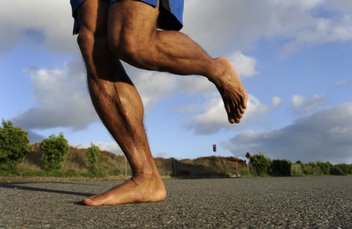
Barefoot RunnerGenerally, I tend to be very suspicious of hot new trends and bandwagons. In fact, I've been known to go out of my way to avoid doing / reading / seeing / trying / etc. things that seem to be taking the world by storm. It's not that I'm contrary by nature; I've just born witness to the stupidity of the masses a lot more often that I have their wisdom.

So it was with barefoot / minimalist running. I grew up running in thick-soled traditional shoes and spent most of my high school distance career striking midfoot; although I did see the light of forefoot striking partway through college, I never thought all that hard about my shoes, and it wasn't until maybe five years ago or so that I first raised my eyebrows at a pair of Vibram FiveFingers the way you might at a large, exotic-looking insect.

Since then, I've done my share of reading on the subject, and shockingly (read: not even remotely shockingly), this seems to be one of those issues that some people tend to get all fight-ey and fundamentalist about. I've lost track of the number of articles I've read evangelizing about how barefoot / minimalist running is the be-all, end-all of the sport and promise it will magically cure whatever leg or foot maladies plague you, or, on the other hand, about how Vibrams are a tool of the devil and it's incredibly dangerous for Westerners accustomed to running in high-tech, mushy traditional shoes to switch to something so hippy dippy and preposterous.

Just as I am suspicious of sensations, I also maintain a healthy skepticism about particularly extreme positions on most subjects. And shockingly (read: not even remotely shockingly), the minimalist running articles that I've found the most compelling and persuasive have been the ones that discuss the pros and cons of both styles, the fringe cases, the "yes- and no-but" cases, and the ones that don't begin with the tacit assumptions that all runners are alike and there is such a thing as the one "best" way of doing anything related to running.

This article from The Science of Sport is such a one. It's not a terribly long read, and I definitely recommend it, but here are a few of the high points that I think don't get nearly enough air time in the ongoing debate about running shoes & foot strike:


  • There are many, many people who run in both types of shoe (minimalist & traditional) and with different foot strikes (heel, midfoot, forefoot) who are healthy, safe, and injury-free and have been for many years.
  • Some people switch to barefoot/minimalist and suffer injuries; others make the switch and find that injuries that have bothered them for years disappear.
  • Although forefoot striking causes less loading on joints and is usually associated with more efficient patterns of movement when all other things are equal, our bodies become efficient at whatever we do with them most often, so someone who has been a heel striker for thirty years may find that forefoot striking is actually less efficient for them, at least at first (and sometimes indefinitely).
  • Heel/midfoot striking and forefoot striking use vastly different muscles (more anterior for heel/midfoot, more posterior for forefoot), and runners who attempt to switch from one to the other may have dramatic strength imbalances that can result in injuries or over-training if they don't start out very, very gradually.
  • Whether or not switching to minimalist shoes or forefoot striking makes sense for a given runner is a very individualistic question and depends on a number of factors including running goals, mileage, and history of injury.


For my part, I can honestly say there is no way I could possibly force myself to land on my heels when I run regardless of what shoes I was wearing, because it requires landing with my foot out in front of my body, which puts a ton of uncomfy force on my knees and hips. (I do catch myself doing it a little when I have to slow down quickly, which illustrates the idea that heel striking does create a braking action; this is part of the reason why heel striking is often not a super-efficient way of transforming energy into forward motion.) When I first switched from midfoot striking to forefoot striking, it was definitely a very long and gradual process that involved cutting my mileage back significantly and then building it up again over the course of several months as my calves, hamstrings, and glute meds became strong enough to keep up with my cardiovascular system. I definitely remember overdoing it on a few occasions and then having to deal with mild Achilles tendon or calf strains as a result, but over time that stopped, and eventually I found that the constant shin splints that had plagued me for as long as I could remember pretty much disappeared.

I've never attempted to go "full Vibram," but a few months ago I did get a pair of racing flats, just because I was curious about how much difference a lighter shoe might make in shorter races. They have a significantly smaller heel-toe drop than my more traditional Asics and also a lot less cushioning. Because I've been running on my forefeet for years, I haven't had a lot of the issues that midfoot & heel strikers can have when several centimeters of extra heel is suddenly gone and the calf and heel cord are forced to suddenly do a bunch of extra work. Still, I've learned not to try to run in them for more than about 10K at the very outside unless I'm running at race pace; it turns out that at slower speeds, especially as I get tired, I find my heels tapping the ground a little more often, and that gets uncomfortable. (The lack of cushioning can also get uncomfortable, but that's a whole other issue.) So I'd give the same advice to people transitioning to racing flats as I would to people considering barefoot / minimalist running -- start slowly, increase mileage gradually, and listen to your body, erring on the side of taking an extra rest day now and then rather than on the side of ending up injured.

So yeah. To me this is absolutely one of those issues where the answer to the question "Which is better?" is "It depends," and I always applaud folks who don't pretend a rich and complex issue is cut-and-dry. Run on, Science of Sport! :)