Showing posts with label orthotics. Show all posts

Wednesday, January 27, 2016

I go to PT, again.

I was super happy that UCSF was able to book me with the therapist I was seeing back when I had all my hip problems in 2013. He's the head of the department so sees fewer patients & is harder to schedule, but he also happens to be the guy that knows about running, so my doctor wanted me to see him specifically.

We started out as usual with all the basic mobility assessments where he watched me walk, run, squat, balance/hop on one leg, etc., then did some strength testing where he pushed and pulled on my legs in various ways while I tried to resist. The good news is that he said overall my strength is good and my movement/mobility is improved from 2013.

The bad news is that basically my entire left side is clearly significantly weaker than the right--hamstrings, hips, glutes, and wrapping around to my right lats. (Apparently it's kind of like how the left side of your brain controls the right eye & vice versa--the upper body muscles that help stabilize the pelvis/upper leg are on the opposite side. Like if you push off & back with your left leg, it's your right lats/upper core that resists the rotation & helps you balance.) Sometimes those imbalance things are a little tricky to tease out and determine, but this was just so immediately obvious in every strength test he did, even to me.

Before we started I told him about my theory regarding my left foot & how striking wrong & not engaging my arch might be causing all sorts of other problems up and down the line, and the article from AT, and how taping my left foot seemed to work magic, which he acknowledged was not entire ridiculous. (I call that a victory.) After doing all the strength testing & determining my left leg was clearly weaker, he explained how it it could be that weakness further up that's making it hard for me to use my left foot properly. So step 1 is definitely to do some targeted strength work on that left side for a couple of months & see if that helps.

In a way, this is the kind of bad news that's actually good news, in a way--He found a clear, unambiguous problem that *could* realistically be connected to the injuries I've had in my lower left and upper right legs over the last couple of years. It's when I see a medical professional and they just kind of look at me and shrug and say I'm perfectly normal as far as they can tell that it gets frustrating.

As it tends to go with PT, the exercises he gave me for my left hamstring and hip muscles are pretty simple but also incredibly difficult (which is a good sign I need to do them). He also recommended that I go back to doing some single-leg eccentric glute stuff, which I've been neglecting lately. Finally, he suggested that because my left heel and arch are definitely visibly collapsing a bit, even just when I walk, I should stick a Superfeet insert in my left shoe as a short-term solution while we work on strengthening the muscles. So hopefully that will give me some immediate relief.

On the plus side, he did not do this to me again:

I found this picture the other day and it was so cringe-inducing that I felt like it was worth sharing again. You're welcome. :)

Friday, October 14, 2011

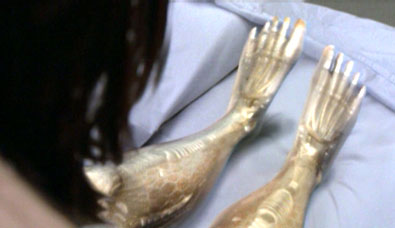
BIONIC!

So my orthotics finally arrived, and not a moment too soon.

In case you've missed all the excitement (by which I mean "excitement"), here's a brief recap of what's been going on around here:

  • I have a moderate case of MTSS that is most likely caused by over-pronation that isn't being corrected sufficiently by stability shoes & semi-custom orthotics.
  • A few weeks of TheraBand exercises to strengthen the small muscles in the lower legs often corrects the trouble but in my case didn't.
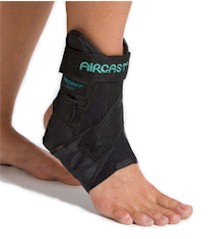
  • I tried running in air casts but found them quite uncomfortable to run in for more than a mile and a half -- they felt like vice grips on the back of my foot.
  • Two weeks ago I was fitted for custom orthotics.
  • During those two weeks, I've developed some yucky tendonitis in my left ankle, which is probably also a result of pronation, and a minor (but painful) strain in my right calf, also probably at least partly from the pronation, which resulted in my not being able to run at all for a good five days.

Lately, the tendonitis & calf strain have really been bigger issues than the shin splints. The shin splint pain I can usually run through; this stuff, not so much. (Based on what I've read, I was also more worried about doing more severe damage with those.)

I was able to go back to running on Monday, though still with not-insignificant pain (I cut the run two miles short, but at least I did something). Tuesday's track workout was a little easier, but especially towards the end, I could feel pain in both areas returning. Plan A for Thursday was to get a marathon pace run in early at the track, since my appointment was in Palo Alto at 2:45 & I wasn't sure I'd have time to do it after. Alas, the universe had other plans. A) It was already hot as BALLS when I got there, B) I forgot my water bottle, C) my Garmin died during the .2 mile jog from my car to the track, and D) my various lower leg ailments were already aching by then as well.

Eff this noise, I decided, & walked right back to my car. I'll just take all my stuff with me to the doctor & then go straight to the track after. I figured this was probably for the best anyway, since I'd then have the orthotics.

So let me tell you about them:

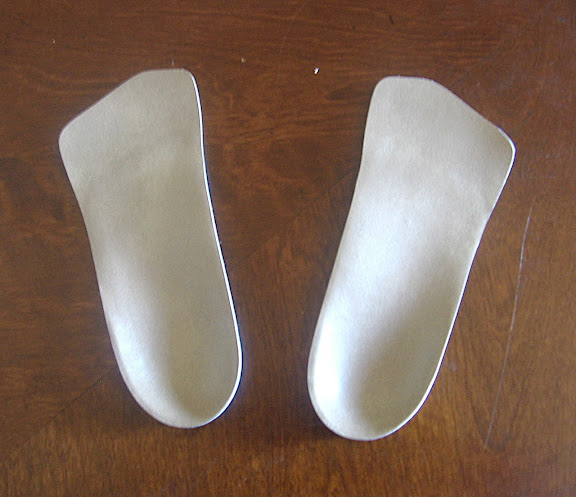
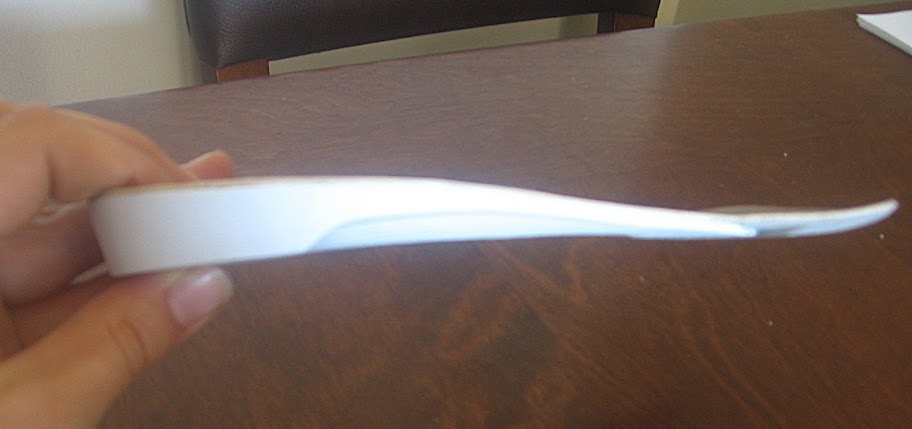
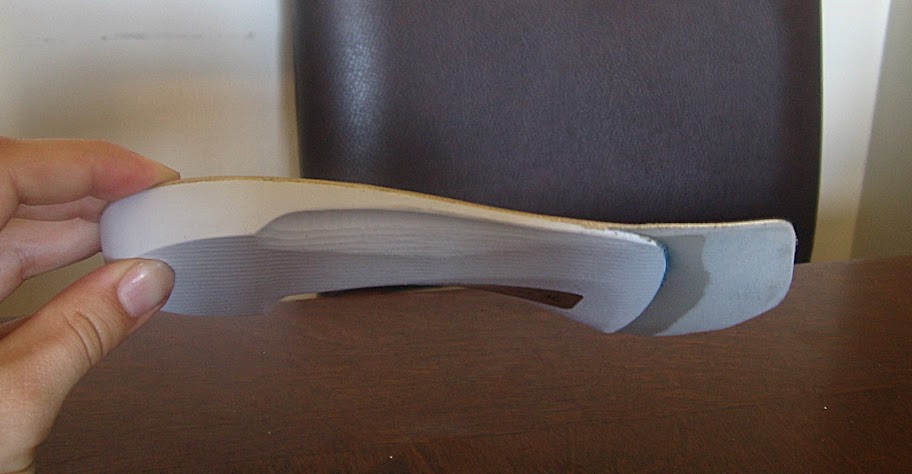
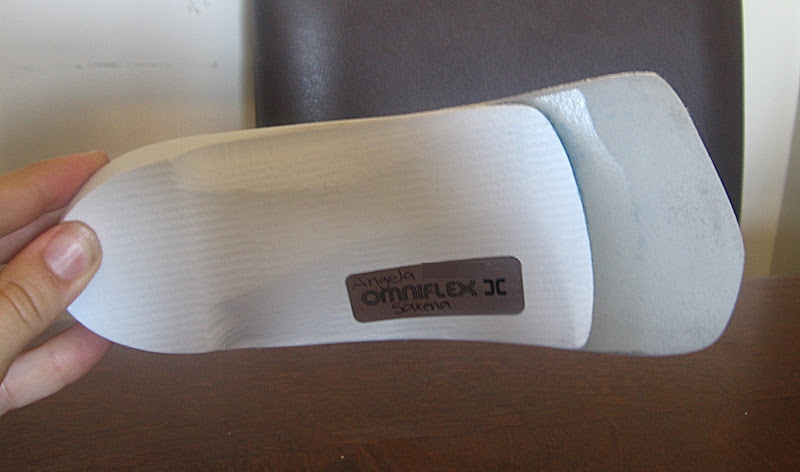
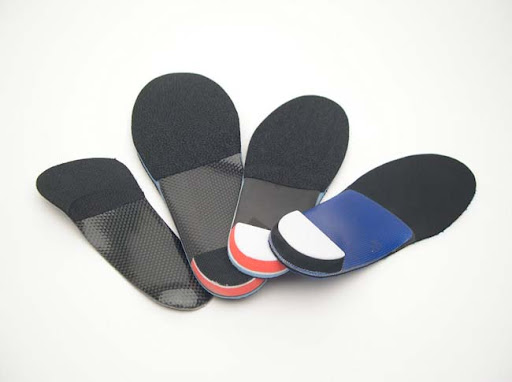
  • As you can see, they look kind of like little duck feet, because there's no toe part; they only fill up about 3/4 of the bottom of the shoe.
  • The top is made from some kind of think vinyl-like material, but the rest is HARD hard plastic.
  • When I first put them in my shoes and put them on, they felt really slippery, which worried me. Then Dr. S told me that the customs go underneath the original inserts that came with the shoes.
  • They are guaranteed for two years (as compared to the semi-customs, which are good for about three pairs of shoes, which for me these days works out to about five or six months, depending on the shoe).

orth 1

orth 2

orth 3

Once I had both the orthotics and the original inserts back in the shoes, the difference was immediate. One way or another, these were going to feel a lot different than my old ones. I couldn't wait to go do my 10 mile MP run.

"By the way, sometimes there's a little bit of an adjustment period," says Dr. S., "so be sure to start off with a shorter run to see how they feel. Just a couple of miles, maybe. Don't take them on a ten miler or anything."

Uhhh...okay, I thought. This is going to throw things off a little. But I nodded my assent anyway, because, hey! Custom orthotics!

On my way back to the city, there was a wreck on 101 north, which meant I didn't get home until after 4:30, which meant I was not going to the track, because going to the track at that point would mean getting home around 6:30 and not getting to park my car anywhere. Which was just as well, I figured, given Dr. S's warning about starting off with a shorter run.

But I did need to get at least some MP miles in, so I decided that an easy warm-up mile and five MP miles wasn't too unreasonable, & I could make up the others tomorrow.

And wow! What a difference! No tendonitis pain. Almost no calf pain. Almost no shin pain. Even more remarkable, my lower legs felt almost normal in the hours following the run. (That's normally when they feel the most beaten up.) Incredible.

It's only been one run, so we'll see how things go in the next few days, but as of right now, things are looking pretty good!

Friday, September 30, 2011

Marathon Training, Week 5: In Which Dr. S. Tolerates My Extra-Special Brand of Neurotic

Ah, the smell of wet plaster in the morning...

Today was visit #3 to my PAMF podiatrist, Dr. Saxena.

The briefest of recaps from visits #1 & 2:

  • I have a moderate case of MTSS that is most likely caused by over-pronation that isn't being corrected sufficiently by stability shoes & semi-custom orthotics.
  • A few weeks of TheraBand exercises to strengthen the small muscles in the lower legs often corrects the trouble but in my case didn't.
  • The next steps were to try custom orthotics as a long-term preventative measure & air casts as a temporary measure to let the damaged soft tissue heal. Also, I can keep following my same training schedule as long as I don't experience any bleeding-out-the-eyeballs levels of pain.
  • I got the air casts but found them quite uncomfortable to run in for more than a mile and a half -- they felt like vice grips on the back of my foot.

(You can read about visits #1 & #2 in greater detail here and here, if you're, like, super into reading about podiatry or shin splints or Paula Radcliffe's bunions. Or if you're in the Bay Area & looking for a good podiatrist.)

So I went in today to be fitted for the orthotics. Now, I took my camera & had this whole grand plan involving documenting the process step-by-step, but it turns out to actually be a pretty quick, undramatic process and was over before there was really anything to document. (It also turns out that you have to lay face down on an exam table while you get your feet wrapped in warm plaster, so as you might imagine that is kind of a limiting factor.)

Here is a picture I found on the internet to make up for it.

orthotics fitting 1


It was pretty much like that.

(To prove I'm not completely morally bankrupt, here is the source.)

Regarding the air casts, Dr. S speculated that my feet were still trying to pronate since the orthotics I have aren't quite enough, and rolling against the hard plastic splints (hence the vice-grip-type pain). His take was that, since running in them for 1.5 out of, say, ten miles basically accomplishes nothing, that I should forget about them for now & try them again when I have the custom orthotics (which should take care of the pronation).

While he wrapped & molded my feet in warm plaster, Dr. S & I chatted a bit about running & marathon training in general (remember that he was a competitive high school & college runner & a 2:45 marathoner). I think if you go to see him, it's important to know that he is very straightforward as doctors go and not so much about the beating around the bush and sugarcoating things, which I definitely appreciate. This wasn't too surprising after reading his Yelp reviews, which are mostly quite good with a few abysmal ones here & there. As far as I could tell, people who gave him low ratings seem to want more of an avuncular sycophant who will confirm what they already believe (or want to believe) than a skilled doctor who will be straight with them & get them healthy again.

This was in evidence when he asked me if I had any particular goals for CIM, like qualifying for Boston. I told him about how I thought somewhere in the 3:20 - 3:30 range was probably a reasonable expectation based on my times at other distances, but that since it was my first marathon I was much more concerned with learning the preparation process and having a strong race. He asked me what my 10K time was and I told him around 44 minutes. "Yeah, you've got to be faster than that to run 3:20," he replied frankly. Heh. I'm sure this is completely true and I will be lucky to break 3:30 even if I have a perfect race.

We also talked about my mileage & how I was approaching training. I told him how I had started my marathon training at about 40 miles per week & wanted to peak somewhere between 50 & 55 miles per week. He said he firmly believed that 40 miles a week is about the minimum in terms of getting through a marathon with any modicum of health. (I'm pretty sure he meant people who are running with some sort of time / performance goal in mind, not people whose only goal is to finish.) "But obviously," he added, "the more you can run, the faster you'll be." His opinion seemed to pretty much be that 40 miles / week is a minimum for finishing a marathon safely, healthily, & with a respectable time, and that you really needed to be closer to 80 to really be strong at that distance. He's pretty much the first doctor (or health / fitness professional of any kind) who has actively encouraged me to build mileage as much as possible (without getting injured, obviously) as opposed to constantly warning me to back off, cut back, be conservative, etc.

Finally, we talked briefly about how I am pretty much obsessed with worrying about stress fractures. Our conversation went something like this:

    Me: "So, if I had a stress fracture, I would know it, right? Right? Because I pretty much worry about this every moment of every day."
    Dr. S: "Probably. But not necessarily. They can happen suddenly but it's very rare. You probably should not worry about this every moment of every day."
    Me: "Okay, but how would I know?"
    Dr. S: "Can you hop on one foot?"
    Me: [Hops on one foot]
    Dr. S: "And the other?"
    Me: [Hops on the other]
    Dr. S: "Does it hurt?"
    Me: "No..."
    Dr. S: "Yeah, it's pretty unlikely that you have a stress fracture."
    Me: "Okay, but if I did start to get a stress fracture, how would I know?"
    Dr. S: "So if there's a spot in your leg that pretty much hurts the whole time you're running and then you're limping after, then you might have a stress fracture."
    Me: "Oh, okay. Because my legs don't usually hurt much when I'm running. It's mostly after."
    Dr. S: "Yeah. That's because you don't have a stress fracture."
    Me: "Okay."
    Dr. S: "Seriously. If you had a stress fracture, you probably would not be able to run at all. So chill."
*dramatization

So, you know. That made me feel better.

So yeah. The orthotics should be ready in about two weeks; at that point I'll go back to have them fitted into my shoes (though Dr. S. said I could still take them out & use them in other shoes, just as with my current ones). In the mean time, I'm doing alright, MTSS-wise. Every now & then I get a little stabbing pain in one of my shins, and the medial areas are still very tender after I run, but for the most part it doesn't interfere too much. (Also, ice helps a lot with the pain. Which, all things considered, really isn't all that severe anyway.)

Tune in two weeks from now when SF Road Warrior finally becomes FULLY BIONIC!!

Friday, September 16, 2011

I Do Not Wish to Become Bionic. Or Destitute.

bionic legsOn Monday I went back to the sports podiatrist in Palo Alto (remember? Runner? Boston qualifier? Duathlete? Podiatrist to the Stars? That's the one).

Something I'm learning about doctors is that they always have really high expectations for your body. Typically I will go to have a thing treated, then go back a few weeks later for a follow up; they're like, "So how's it doing?" and I'm like, "Oh, pretty good, it seems to be a little better," or "Oh, great, I'm not incapacitated by pain anymore." Then the doctor will examine whatever it is with a disapproving look and say something like, "This should really be much better by now." This always makes me feel kind of anxious because I feel like s/he is insinuating that I haven't been trying hard enough to make my body heal itself.

So it was with the podiatrist. I've been faithfully doing my TheraBand exercises 4-5 days per week, and although my shin splints are definitely still there, I haven't had any utterly miserable days since my last visit. I assumed this was some kind of progress. Then he started pressing around on my medial tibias until I cried uncle. That was when he got the disapproving look.

Since I've had the shin splints for years, they don't go away with less mileage, and a few weeks of strength exercises hasn't gotten rid of them, he said that the next steps were to try fully custom orthotics and try running in air casts for a while. Sometimes, he said, people are just too biomechanically messed up for their bodies to be able to deal with something like this on their own. (Okay, maybe he didn't put it exactly like that.)

Maybe this doesn't sound like a big huge deal, but it kind of feels like one. I have always been kind of biased against braces and orthotics and such except in the case of serious injuries; everyone I've talked to about it and everything I've read (that's credible) says that the net effect of things like that is to weaken the small stabilizer muscles in the feet & lower legs. (This is where I can hear the minimalist shoe people starting to yell about the evils of modern shoes. Believe me, don't think I haven't thought about trying the creepy toe shoes on the off chance that it makes a difference, but it's not something I can start working on with a marathon in 10 weeks.) Also, the idea of running with all sorts of little pieces of medical technology strapped to my legs and feet makes me feel a little like the Bionic Woman or something, and that's an icky feeling. Like my body, in and of itself, has been officially deemed Not Sufficient.

air castSigh. To be honest, it's kind of a moot point right now. The air casts aren't covered by insurance, and the cheapest I've been able to find them for is about $40 each, so $80ish in all. The orthotics are mostly covered; I'd pay 20% of somewhere between $350-400, so $70-80, plus whatever they'd charge me for the fitting. The fact of the matter, though, is that cost of the marathon and hotel room is probably more than I really should've spent on something I didn't actually need, and I certainly don't have a spare $200+ sitting around to spend on medical bills. (I've already spent $50 on the two visits alone.)

On the other hand, there is a part of me that's sufficiently terrified of having paid for this race and then not being able to run it because the shin splints suddenly went rogue on me that I'm still seriously tempted to just eat the cost of one or the other. These days I get a little panicky any time I feel a sharp pain anywhere in my shins and start hyperventilating about the possibility of ending up with a stress fracture. So maybe it'd be worth it, just for the peace of mind.

Sigh.

Monday, August 22, 2011

Bay Area Excursions: Podiatry Edition

When I worked in Redwood City, taking care of business on the Peninsula was relatively simple. Most things were either on the way to or from work, or, on occasion, not too terribly farther south that the R-Dubs. These days, though, Peninsula business requires a special trip, so I try to save up those errands when I can and take care of them all in one fell sweep.

pep boysTake maintenance on my car, for example. I have a very special six-year relationship with the Pep Boys in San Carlos, and don’t think for a moment that just because I moved 30 miles away that I’m about to go through the torturous process of finding a new auto mechanic in the city. (It does help that my car only requires service every 10,000 miles, and that since moving to SF, I only drive it about 20 miles a week.)

Now, that doesn’t mean I’m going out of my way to make a special trip. Nope; just add it to the pile of Peninsula business to be taken care of the next time it’s convenient.

Somewhat unfortunately, I haven’t had to be on the Peninsula for anything specifically scheduled in a while. About three weeks ago, though, you may recall that I made an appointment with a sports medicine podiatrist in Palo Alto, so this morning I packed all my errands into my service-needing car and left the cold, nasty drizzle of SF for some Peninsula sunshine.

sf to pa

I traveled to the Palo Alto Medical Foundation to see Dr. Amol Saxena. Like my beloved Pep Boys, Dr. Saxena is a good 30 miles away from me. Surely there are perfectly adequate sports podiatrists in San Francisco, you may ask? Well--yes. But after spending countless hours with doctors and physical therapists, one of the biggest things I've learned is that finding the right person to treat you (particularly for a running issue) is everything, and doctors are certainly NOT all created equal. You've got to do your research. So I did mine.

Here are a few of the reasons why I waited three weeks and drove 30 miles to see Dr. Saxena:

    pr bunion
  • He is a runner / duathlete with 13 marathons, several Bostons, and multiple World Duathlon Championships under his belt.
  • He went into podiatry because of his experiences being treated for running injuries in high school and college.
  • He is affiliated professionally with the San Francisco Marathon, Stanford University, Palo Alto Run Club, USA Track & Field, Runner's World, and the Nike Oregon Project.
  • He has / had numerous elite & Olympic runners as patients, including Alan Webb, Paula Radcliffe, Shalane Flanagan, and Alberto Salazar. (I figure if he's good enough for them, he's good enough for me, right? Heh.)

(By the way, those are Paula Radcliffe's bunions, up there. That's what Dr. Saxena fixed for her.)

So yeah. 3 weeks and 30 miles seemed like a small price to pay.

After getting vaguely lost in the small city-state that is Palo Alto Medical Foundation (I always leave ridiculously early for doctor appointments for the same reason I leave ridiculously early for races; it is a sad fact of my existence that if it’s possible to get lost, I will get lost), I finally made it to Dr. Saxena’s exam room, which is hung with race bibs and autographed photos and copies of running magazines picturing athletes he's treated.

When I made the appointment, the receptionist requested that I bring my running shoes and inserts; having recently changed shoes and suspecting that my old shoes might have had something to do with my shin splint flare-up a couple of months ago, I brought my old Kayanos in addition to my new Brooks (also my Mizuno flats, but those didn’t come up much).

A few fun facts about Dr. Saxena:

  • Dr. Saxena can identify the make and model of a running shoe with a sidelong glance.
  • Dr. Saxena can identify your foot / running shoe type by watching you march in place for approximately three seconds and then stand on your tiptoes for approximately two seconds. No fancy pressure pads or treadmill videos for him!
  • Dr. Saxena knows the approximate dates and course profiles of every major road race in the area (and probably a bunch that aren't).
  • Dr. Saxena makes no bones about his opinions of different running shoes.

I’d been telling him about how my shin splints come and go, and how they’d gotten particularly bad in the weeks prior to my changing shoes. I told him about how my Kayanos had sort of felt worn out, even though they’d only had about 380 miles on them.

This kind of made Dr. Saxena laugh a little. As a general rule, he’d told me, Asics last about 250 miles. “They’re comfortable,” he admitted, “but it’s all marketing.” (Dr. Saxena intimated later that he personally could not run more than about 3 miles in a pair of Asics.) The Brooks, on the other hand, he told me, should last 350-400 miles. I find this kind of hilarious, given that the Kayanos generally cost ~40% more than the Brooks Adrenalines.

Dr. Saxena did not have strong feelings about my orthotics except to say that the reason I’ve been feeling as if I have stone bruises on the balls of my feet could be that they are slightly too long in the heel, causing the orthotic to ride slightly forward in my shoe relative to the part of my foot that it’s been molded to. That means that the very front part of the arch is essentially pressing up on the ball of my foot (where there is apparently a cluster of rather temperamental nerves). Dr. Saxena advised taking the orthotics back to Roadrunner Sports and asking them to trim up the heels a little.

Like everyone else who’s ever looked at my feet and legs, Dr. Saxena seemed pretty positive that my shin splints were caused by moderate pronation and the tiny muscles in my lower legs not being strong enough to pull them back into alignment completely with each stride. For this, he recommended strengthening exercises with a Theraband. For the pain, he recommended regular icing (which is my usual approach anyway). We did talk briefly about ibuprofen, and it seems that Dr. Saxena agrees with my best buddy K-Starr on that point: Ibuprofen is known to interfere with the healing and strengthening process, and the relative benefits (barring a significant injury like a sprained joint) are minimal.

For the next three weeks, I am to continue running normally & increasing my mileage, do my daily Theraband exercises (sidenote: I wonder what percentage of my life I’ve spent doing Theraband exercises?), and ice for pain. On Sept. 12, I am to see Dr. Saxena again for a follow-up. He seemed to think that my particular case is a fairly mild one, if chronic, and that the Theraband work should take care of things. On the off chance that it doesn’t, he described to me a few more options that are sometimes necessary in more severe cases:

  • Fully custom orthotics (~$400; The Footbalance ones that Roadrunner Sports will do in-house for you are more semi-custom, according to Dr. S., but if they work, they work.)
  • Aircast ankle braces
  • Shockwave therapy (to break down scar tissue in the tib med area)

Rad!

After my visit with Dr. Saxena, I went to Pep Boys and had my car serviced, then popped over to Roadrunner Sports (just a few blocks over) to explain about my inserts. To my great pleasure, they did better than just trim it up; they replaced the too-long-in-the-heel inserts with a brand spankin' new set in a smaller size. Thanks, guys! After that, a few more errands on the Peninsula, then back home (where, thankfully, it was no longer drizzly and nasty).

So we'll see how the Theraband exercises go. They are yet new and different from any other shin splints exercises anyone has ever prescribed for me, so I'm willing to try them for a few weeks (hey, it's Dr. Saxena, after all!). I'll keep you updated on how it goes. In the mean time, if you're local and find yourself in the market for a podiatrist who gets runners, you might consider heading over to PAMF.

Monday, August 15, 2011

A Few Myths About Orthotics

orthoticsDue to mild pronation, I've run in a stability shoe for as long as I've been getting my shoes professionally fitted. That was towards the beginning of college; before that I honestly can't say what type of shoe I was running in, because my basic approach was to try on a bunch of running shoes until I found ones that felt comfortable. Then there was the one year we couldn't afford shoes and my coach gave me a pair to wear for the season, which I think were actually used and already worn out. Given all that, it's probably not surprising that I suffered from horrendous shin splints for years that all manner of leg and foot exercises did nothing to fix. Around the same time that I started wearing a stability shoe, I also started trying to switch to a forefoot strike; between these two things, my shin splints all but disappeared in a few months.

Earlier this year, I got really curious about racing flats and started looking into getting a pair for shorter races. At the time, flats weren't something I knew much about. In high school I wore spikes for time trials and races 1600 m or shorter or regular trainers for workouts and two mile races; it never occurred to me that there was any other option. (Mostly I wanted them for 5Ks & 10Ks - it's hard for me to imagine running farther than that with that little cushioning.) In an effort not to walk into a running store completely clueless on the topic, I tried to at least do some research on how flats are fitted compared to trainers and what different types exist. Alas, there wasn't as much detailed information out there (at least that I was able to find) as I'd hoped. So, armed with precious little knowledge beyond the basics, I put myself in the hands of the shoe people at Roadrunner Sports.

And I learned a few things right away. First, that there are two types of racing flats: performance neutral or "true" flats (very little in the way of cushion and support), and performance stability shoes (slightly more support, mostly aimed at preventing overpronation). After video-taping a few seconds of me running barefoot, they confirmed what I already knew: high arches + flexible ankles = not insignificant overpronation. Which, one of the salespeople explained to me, meant that running in a true racing flat was probably out of the question.

On the off chance that it might help, they did a quick custom orthotic for me and we did a few more videos of me running in the neutrals with the orthotics. It made some difference, but not really enough. Next, we tried a few different performance stability shoes. In those videos, my pronation looked similar to when I was wearing the neutrals with orthotics. When we added the orthotics to the stability shoes, the pronation was almost gone. So I left that day with my Mizuno Musha Wave 3's and a pair of molded inserts.

In the last couple of months before this, the shin splints I thought I had banished back in college had been sneaking back up on me. They weren't as bad as they had been; just noticeable enough to be annoying (and worry me a little). On the off chance that it might do some good, I started switching the molded inserts into my trainers when I wore them. (It didn't.) As I've mentioned lately, I think they've been getting better in the last few weeks; I'm now running in my new Brooks and the molded inserts in an effort to add every little bit of stability I can.

It's been a while since I discussed all this with someone with an actual medical degree, though, so recently, I made an appointment with a sports medicine podiatrist, just to see what he thinks. Then today, I ran across another Gina Kolata article regarding orthotics and running.

That was kind of a bummer.

Well; sort of. It turns out that yes, orthotics really do work in a lot of cases in that they often do let people run or walk more or less pain-free when they weren't able to before. On the other hand, there's apparently a lot of bad information out there about orthotics as well. The article goes into a lot of detail, but here's what I took away from it in terms of myth-busting:

Myth#1: Doctors understand how orthotics work. Apparently they don't, really. It's more a process of trial and error than anything else.

Myth #2: Doctors can predict what effect a given orthotic will have on a given patient's biomechanics. Unfortunately, ten patients with the same biomechanical problem may react to the same orthotic in ten different ways. Depending on how a certain patient responds, the issue may get better, worse, or stay the same.

Myth #3: Orthotics change a person's running form & kinematics (how the skeleton moves during running). Even when a patient reports that orthotics are working, there is rarely evidence that s/he is actually moving differently as a result of the orthotics. (On the other hand, there is evidence that wearing orthotics can reduce muscle strength.)

Myth #4: There is good scientific / medical evidence that orthotics prevent injury. There isn't. There are lots of studies, but most of them are not scientific or lack rigor. That doesn't mean that orthotics don't prevent injury in certain cases, just that there is no real evidence that they do. (The article does site one well-controlled scientific study where orthotics did appear to reduce injury in a group of soldiers; but again, even in the soldiers who suffered fewer injuries, the researchers did not see evidence that the orthotics changed anything about their biomechanics. Also, the soldiers chose their own orthotics based purely on what they thought was comfortable, without any input from a doctor at all.)

The article wraps up with some advice from a professor of biomechanics: Instead of turning to orthotics right away, he says, most athletes would do better to instead work on strengthening the muscles in the affected parts of their legs.

So really, who knows whether those custom inserts are really doing anything for me or not? I'll definitely be very interested to see what the podiatrist has to say about all this next week.