Wednesday, August 10, 2011

This Is How I'm Gross

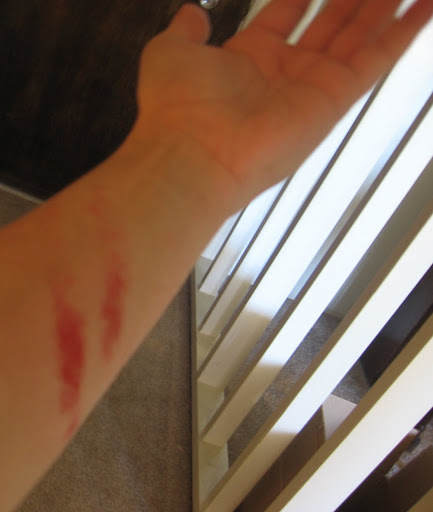
One running problem I have not solved since moving in with my boyfriend a year and a half ago is what to do with disgusting, dripping wet clothes after a run. When I lived in my own place, there was this bizarre not-a-wall structure between the front door and the living room that, as far as I could tell, served no real function, so I co-opted it as a clothes drying rack. (You can kind of see the not-a-wall in this picture -- try to ignore the gross polo injury; I tried to find a less disgusting picture of the not-a-wall, but apparently I didn't take many pictures in that apartment. Then again this whole post is about being nasty so maybe it kind of fits.)

not-a-wallA Nasty Parable (to set the tone):
Friends come over and immediately notice all the damp running / riding clothes draped over the not-a-wall.
Friend: "Oh, is your dryer broken?"
Me, belatedly: "Don't touch that."
Moral: Don't be a bad friend & leave your stank out where your friends might accidentally come into contact with it.


There is no such structure anywhere in our house. Even if we had such a structure, I feel fairly confident that Don would veto the displaying of damp, stinky running clothes in public areas like that. (I have a lot less shame (read: social grace) than he does.) Even in non-public areas, though, there's no good place for hanging damp clothes to dry so they don't mildew in the hamper. I'm not arguing that this is a difficult problem to solve; just pointing out that I haven't solved it yet, so it is still a problem.

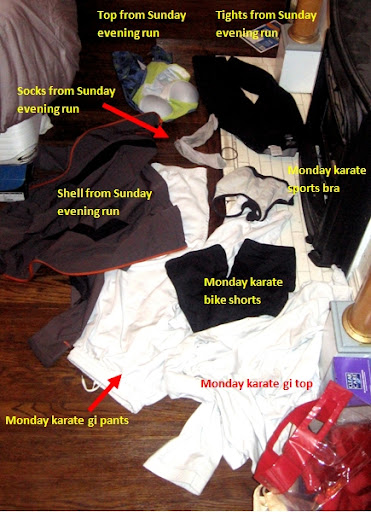
The default "solution" is that my bedroom floor is primarily used as a surface for spreading out wet workout clothes to dry:

minefield of disgusting

While I will admit that this is totally gross, it's maybe not quite as totally gross as it sounds. Before I moved in with Don, I lived on my own for four years, during which time I had accumulated too much stuff and furniture not to need a separate room for it. (Don would not tolerate this for a SECOND if we had only one bedroom.) While it's technically my "bedroom," it mostly gets used for storage, so it's not like we're walking around in there a lot.

Except when we are. I went in there Tuesday morning to get dressed (my clothes live in that room) and possibly toss some now-dry workout clothes into the hamper; in the process of picking my way through the minefield of sweaty disgusting, my foot brushed against the top I ran in on Sunday evening.

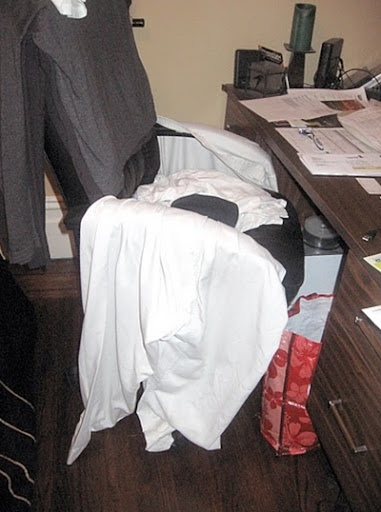
don's chair(Right: Don has a vinyl desk chair that he uses to solve the damp workout clothes problem. Vinyl = not gross to get sweat on, as long as no one else has to sit in it. He is definitely the classy one in this relationship.)

It was still wet. Not like kind-of-damp and/or moist; like squishy, sopping WET.

My first thought: SICK.

My second set of thoughts: Wait a minute. That's from thirty-six hours ago. Shouldn't it really be dry by now?

Could it be that my running-fu has evolved to the point that my sweat no longer obeys the laws of physics?

What other mystical properties might my sweat have acquired?

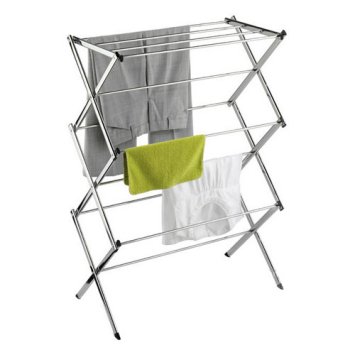
My third thought: Girl, you are NASTY and your living conditions would make your grandmother weep bitter tears of defeat and disgust. Get thee to Target / IKEA / The Container Store / whatever and get yourself some of this action:

clothes drying rack

We're talking like $35.00 here. This is not rocket science.

Seriously. What is *wrong* with me people?

Tuesday, August 9, 2011

"Vitamin I"

IBI am a recovered Ibuprofen-aholic.

By and large, drugs have always seemed to affect me less than other people. To give you a sense of the scale we're talking about here, a couple of years ago, an outpatient procedure I was supposed to have couldn't be performed because eight times the normal amount of anesthesia failed to knock me out. Sleeping pills have never worked on me. Caffeine doesn't appear to have much effect either. Tripling the dosage of any cold or allergy medication is standard operating procedure, if things are bad enough that I even bother taking it.

When I was younger and suffering from debilitating menstrual cramps (not to mention routine soreness or the odd injury from running or gymnastics), I learned very quickly that taking things like Advil, Aleve, or Tylenol at the recommended doses was pretty much equivalent to eating candy for all the good it did. Even at higher doses, it was kind of six to one / half a dozen to the other whether any break in the pain that happened to occur was due to the drugs or would've happened on its own anyway. My doctor didn't want to prescribe anything stronger to a kid, so my mom would sometimes give me hydrocodone prescribed for her if it got really bad, just so that I could sleep / function / etc.

Though it didn't help with pain, I did still occasionally take Ibuprofen for its anti-inflammatory properties when I felt particularly sore or had a legitimate injury. When I was having a lot of knee pain several years back, my doctor prescribed 800 mg tablets of Ibuprofen. (Sidenote: This has never made any sense to me. OTC Advil tablets contain 200 mg of Ibuprofen and there is certainly no one stopping people from taking four of them at once. Plus, generic OTC Ibuprofen is usually cheaper per mg than the prescription stuff anyway.) When it didn't do much for the pain I started doubling it, which seemed to have at least some noticeable effect. (Not that I'm advocating this...Definitely DO NOT try this at home, kids.)

This kind of started a bad habit. If I was feeling sore from a run, I'd take 1600 mg of IB. Same thing if I was having weird pain I didn't understand. Sometimes I'd even take it before a run, under the impression that doing so would prevent inflammation and soreness afterward. My doctor happily refilled the prescription any time I asked. (Sure, I could've just taken the OTC stuff, but there was something a little unsettling about the idea of swallowing eight of the little red pills compared to just downing two of the big, white horse tablets. Upon reflection, I probably should have paid more attention to that unsettling thought.)

Then I started reading more about inflammation, pain, Ibuprofen, and how it works. Particularly, how it works in athletes, and how it works with regard to pain and inflammation that are not due to an acute injury.

First, the obvious:

1) Pain is how your body communicates with your brain. It informs us as to how our activities are affecting our bones, muscles, connective tissues, etc. Sometimes the message is, "Whew, that was a little tougher than we were used to! Maybe an easy day tomorrow." Sometimes it's, "Hey, we tweaked muscle/tendon/etc. xxx a little & need to rest it." Sometimes it's, "Seriously, bone/muscle/etc xxx isn't really strong enough for that right now. Back off." Shutting these messages off can be dangerous because it sometimes means we think we're stronger, healthier, or in better shape than we are, do too much, and wind up dealing with a more serious injury.

This is something I learned a lot about the first time I was in physical therapy. The way that PT put it: If the pain is not so bad you can't function, let yourself feel it, because what the pain does will be the best guide as to whether or not you should run, how much, how hard, etc. If it hurts so bad that you can't function without a pain killer, you shouldn't be running anyway. The time to turn that message off is when you already know you can't run due to an acute injury, and blunting the pain isn't going to tempt you to try.

Next, a few things that seem to be less well-known among runners (they were certainly unknown to me, up until a couple of years ago). This article does a pretty good job of explaining it all in more detail, but here are the 10-second summaries:

2) Taking painkillers before a workout doesn't prevent pain during or soreness after. When researchers poll endurance athletes at water stops during a race about how much pain they are experiencing and then over the next several hours and days about how much residual soreness they have, there is no difference between the responses of athletes who took painkillers and those who didn't.

3) Anti-inflammatories (like IB) can blunt the training effect. Training makes us stronger is because training is tissue damage, and our body responds to tissue damage with an inflammatory effect that helps muscles, bones, and connective tissues toughen up and become stronger. Anti-inflammatory drugs can inhibit that natural inflammatory response, essentially rendering your workout a waste of time. Kelly Starrett (DPT and awesome SF Crossfit coach) goes into more detail about this particular issue. (Love him, BTW.)

4) Anti-inflammatories (like IB) can actually INCREASE tissue inflammation when taken before or during a workout. Unlike the natural, beneficial inflammation that occurs after a workout that makes you stronger, chemically-induced inflammation can impair performance during a workout by adding to the stress that the body is already under.

5) Painkillers can impair kidney function when taken before a workout. Because kidneys are responsible for filtering waste out of the blood and regulating electrolyte balance, this can be a big deal during a hard workout or race (and the longer the event, the bigger the risk). If kidney function becomes poor enough, it can lead to hyponatremia, a situation where sodium levels in the blood drop below what is safe.

ice bathSo, you can maybe see why, at a certain point, I'd ask myself how badly I really need to be taking painkillers at all (barring, obviously, suffering some kind of heinous injury like breaking a leg or something). These days, I'm completely off of them -- I don't even take them for headaches. Instead, I've really taken K-Starr's advice to heart -- the best (and most side-effect free) strategies for managing routine soreness and mild tweaks are proper nutrition & hydration, ice (I mean really -- who DOESN'T love a good ice bath!?), stretching, massage, etc. I think it's a little easier for me because it takes so much of anything to have an effect anyway, but I also think that it's wise to treat drugs as the last line of defense whenever we can, rather than the first.
Monday, August 8, 2011

Week In Review: July 31 - Aug 6

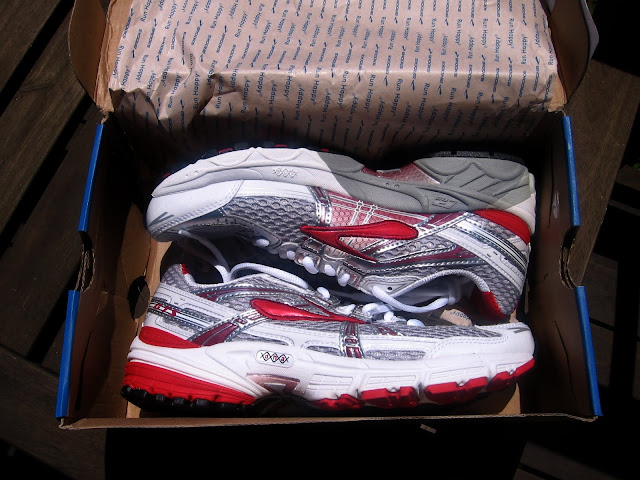
Running ShoesThis is my weekly training journal. Including it in the blog gives me a little extra accountability in the mileage department & helps me stick to my schedule. :)


Having raced hard and finished strong on Saturday, I decided to take a few days off at the beginning of this week to let my legs rest. Somewhat arbitrarily, I decided that I'd give it til my new shoes arrived. (Sadly, although they arrived on Tuesday, it was late enough in a busy day that I wasn't able to take them out for a test run until Wednesday.)

Wednesday: 5 miles easy. Running in a different training shoe for the first time in five years or so is a little weird. At several points I found myself getting a little bit paranoid: Does my heel hurt? I think my heel hurts. Is it the shoes? Okay now it's gone. Wait--are my toes going numb? Has that happened before? I think my toes might be numb. Or not. My arch feels all weird. I think. Maybe. Again, my body is weird sometimes. And so is my brain. It will definitely take a few more runs to get a good sense of how the shoes will work out. The only bummer about this run was that I had a small asthma attack about a mile in, which made the last four miles maybe not as much fun as they would have been otherwise, and it was nice to be done.

Thursday: 8 miles easy. This was the day I experimented with trying to find a medium-length loop through the city without too many hills. My calves & associated tendons took a couple of miles to warm up, but after that they felt pretty good, and I held a reasonably strong pace all the way to the end. Will definitely be running this route again! New shoes working out so far.

Friday: 5 miles (1 warm up + 3 x 10:00 @ 10K pace). I was kind of on the fence about doing a speed workout this week, but my legs felt good this morning so I decided to just go to the track and see what I could do. Usually my plan is to jog 3-4 easy miles after a speed workout, but this one took a lot out of me -- I felt like I had to work really hard just to keep my intervals at the very slowest end of my 10K pace. Also, my left leg was throbbing a little, so decided it was probably best to take the 5 & call it good.

I wanted to run Saturday but my legs weren't feeling so great after the track stuff Friday (mostly right tib med). I figured I could probably get through 5-7 miles if I tried, but also figured there was a non-zero chance that doing so might preclude the 10-12 miles I had planned for Sunday, so I decided to skip it.

Grand Total: 18 miles

Not a stellar mileage week, but not TOO lame for the week after a hard race (especially considering that the first thing to go after a Saturday race is the Sunday long run. Though this may just mean I need to shuffle things around when that happens). Definitely planning on starting things off this coming week with a nice 10-12 miler on Sunday. New shoes seem to be working out well -- I'll give it a few more runs before I say more about them, but I'm enjoying them so far. :)

Saturday, August 6, 2011

The Gambler

kenny rogers"You gotta know when to hold 'em, know when to fold 'em...Know when to walk away, know when to run..."

Someone was singing this earlier, and I couldn't help laughing to myself a bit about how well it applies to my running life lately. Today I really wanted to run an easy 6-7 miles, but when I woke up this morning my tibias and calves made it clear that this was perhaps not the smartest of ideas. I'm pretty sure I could get through it, but I've definitely learned that the day before a scheduled long run is a particularly bad day to gamble with my legs. I have a feeling that if I ran today, I'd be incapable of running 10-12 miles tomorrow, and I really don't want to risk that.

Word, Kenny. Word.

On the bright side, I finally got an appointment with the running podiatrist in Palo Alto, so I'm really pumped to talk to him about the different types of pain I've been having and whether he thinks there's anything more that can be done about it (because really; 25-30 miles a week should not keep me perpetually on the brink of injury). He apparently keeps busy since the earliest appointment I could get was two and a half weeks away, but better late than never, I suppose.

Sigh. Now if you'll excuse me, I've got some quality couch-sitting to do.

Thursday, August 4, 2011

How To Run 8 Flat Miles in SF

nob hillIt can be done!

To be completely honest, I enjoy having all the hills around here. Because the moderate, rolling hills are so ubiquitous, getting hill training in is really easy, and I know I've definitely benefited from having them in the vast majority of my short-to-medium easy/moderate runs. I wouldn't live somewhere flat for all the world! On the other hand, I don't really want to run hills every single day of my life, so having a few flat loops of various sizes in my back pocket is key.

Often when I want to do a longer, relatively flat run, I head for Golden Gate Park. There's a lot to love about running in the Park -- it's reasonably flat in most places (though you can find hills if you want them), scenic, has water fountains along JFK and MLK every few miles, and there are only a few traffic lights. I do enjoy running in the Park and do it a good bit of the time.

On the other hand, it's not super-close to my house. It's close enough that I can run there and back if I want, but not without a) traversing several large hills, or b) tacking on a good 8 miles (counting the return trip) to get there via a route that avoids hills. It's a short drive, so I can always do that if I want, but unless I'm going to the track I try to avoid driving to running because it means extra time spent in the car and also dealing with parking.

And frankly, as much as I enjoy it and appreciate having it nearby, I've looped Golden Gate Park more times than I care to count, and there are days when I just can't face the monotony. So lately I've been experimenting with different routes, partly to break up my routine and partly because I'm always in the market for big, sweeping, medium-to-long flat loops on days when I don't want to run hills or need an easier route. Today I decided I wanted a medium-length easier run, so I decided to see how far I could get without having to run a crazy hill or just turning around and going back the way I came.

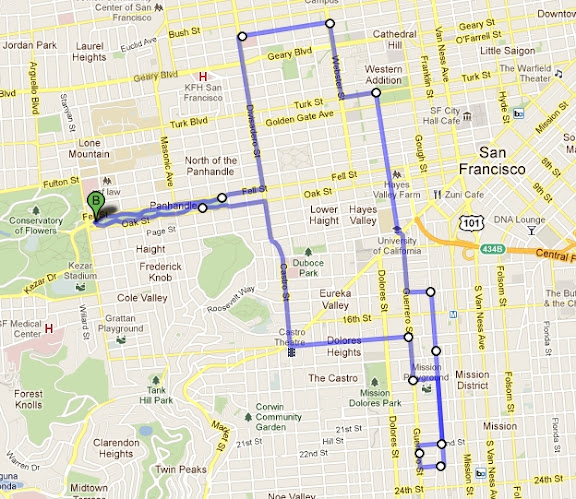
Here's my route! (Click to embiggen.)

(In the interest of retaining some semblance of internet privacy, let me just say for the record that the start / finish point on this map is not where or near where I live or where I started, nor do I live on this route anywhere.)

Full disclosure -- it's not completely flat; going south on Divisadero, there is a slightly detectable uphill grade, and maybe a half mile stretch between Oak and Market that does have a few non-insignificant (but quite short) hills. By and large, though, it is AWFULLY damn pancake-y for a loop that large in SF and avoids any truly ridiculous and heart-breaking stretches (looking at you, 17th between Market & Clayton). This will work especially well when I get back to doing *actually* long runs, because it's not too difficult to just tack on a loop through the park. Still working on some way to add in the nice, flat, traffic-light-free stretch of the Embarcadero, but that's a project for another day.

Wednesday, August 3, 2011

Slow & Steady (But With New Shoes!)

I am still super pumped about having had such a fun and successful trail race Saturday, and about hearing & reading everyone's fabulous SF Half / Marathon stories (jealous!). My quads and hamstrings are still tight from the giant hill and I am having just a touch of lingering soreness in my left calf, but other than that, I feel great. Also, my new shoes just arrived! (Apparently UPS tried to deliver them yesterday at 7:20 pm, which I didn't even realize they did, but no one was home.) I'm planning on giving my calf the rest of today to rest up, & will then try to get in a run every day for the rest of this week. new shoes

My plan for the next few months is as follows:

  • Train hard for Summer Breeze 10K on August 27.
  • Train hard for Race to the End of Summer 10K on September 18.
  • Begin half marathon training in earnest -- this gives me 8 weeks to get ready for Clarksburg Country Run on November 16.
  • If all goes well, run the Cal International Marathon on December 4. The proximity to Clarksburg would make this kind of a tight/weird schedule, but I feel like it can be done.
Part of the purpose of the 10K Summer Tour has been to create some semblance of base-building going into training for longer races. Yes, I've been doing some speed / tempo work as well, but I'm also gradually getting myself back to the point where I can run at least 30 miles a week without winding up injured every ten days or so. I'm hoping that backing up a targeted eight-week half marathon program with four months of pretty solid & consistent running will a) help keep me healthy as I increase mileage and b) set me up for faster times, since I'll be starting out in better condition overall. To that point, I've been in no rush to increase mileage this summer. I've wanted to get up to & stay at around 30 miles, and then very gradually increase from there if things seem to be going well, but that's pretty much it. So I think that since I raced Saturday, I'm going to focus on just trying to get some easy / moderate mileage this week, and maybe a little speed work on Thursday or Friday if I'm feeling really good (since there won't be time for my usual rest day-track day-rest day speed sandwich). After that, I will shoot to get in 30+ miles during the weeks of the 7th and 14th, and maybe slightly less the week of the 20th (race week). (More on the shoes after I have a chance to actually run in them. ;)

Running With Asthma

lungsFunny that it took me this long to write a blog post on this topic -- I think that's what happens when you get so used to something.

I was diagnosed with asthma when I was eighteen months old. From what I am told this whole period was an absolutely terrifying time for my parents. In addition to having extremely scary large-scale attacks a few times a year that lasted for days, I also grew up having exercise-induced attacks. It didn't happen all the time, but sometimes a single lap around the schoolyard was all it took before I was gasping for breathe and fighting to stay upright.

Pretty early-on I was put on an albuterol rescue inhaler plus any number of preventatives (there must have been dozens), but in spite of all of this, I still continued having attacks, both exercise- and mystery-induced, four or five times a day (and night) for somewhere in the neighborhood of fifteen years.

You can imagine how this complicates things for a runner / gymnast / equestrian.

I basically grew up clutching my inhaler the way other kids clutched a favorite toy. My inhaler was my safety object, quite literally. I carried it with me everywhere I went. I kept one by my bed, one in my locker, one in my backpack, one in the school office, and any number of backups in our kitchen cabinet at home. Realizing I had somehow left home without it or didn't know where it was could send me into utter panic. I ran all my track workouts and races holding it in my hand, knowing that as soon as I was across the finish I would need it desperately. (Forget running more than two miles at a time; I wouldn't be able to breathe long enough to finish.) Twice I was hospitalized for week.

Once when I was sixteen and at the doctor for something different, he asked about my asthma and was horrified to hear how much albuterol I was taking.

(Me, totally deadpan: "What?"
Doctor, bug-eyed: "I'm not actually sure why you haven't had a stroke yet.")


So he put me on a new medicine, which changed my life. Suddenly I could go weeks without needing my inhaler, with the exception of running, where I still needed it pretty much every workout. On the plus side, I stopped waking up in the middle of the night unable to breathe and didn't have a panic attack if I realized I'd left home without it. This was all AWESOME.

But I still really wanted to run longer distances. And two miles was still about the farthest I could go before I was gasping for air.

When I went to college, I discovered swimming. I'd never been much of a swimmer before (that is, I could probably avoid drowning in most situations, but I didn't really know how to properly swim). I was really curious to see how swimming affected my asthma, and interestingly, it didn't affect it at all. I could swim 200 repeats for half an hour, and even though I was breathing hard, I never had an attack.

It occurred to me to wonder if this could have something to do with my breathing -- how, when you swim, your breathing is pretty much regulated for you. Short of swimming faster or slower, you can't really change how fast you breathe. Not long after, I started trying something similar with running. For the first time, I started paying close attention to my breathing, and on slower, easier run, I tried to breathe in for six steps and out for six steps. It wasn't easy to learn to do, but for the first time in my life, I found that I was able to run more than just a couple of miles without an asthma attack.

To this day, I am still incredibly mindful of my breathing when I'm running. I don't have regular attacks anymore, I don't have to take a billion preventatives, and think nothing of leaving my inhaler at home fairly often. Most of the time I do use my albuterol 5-10 minutes before a run, which is supposed to prevent acute attacks, and seems to most of the time. Very occasionally, though, I do still have small ones while I'm out running. I've learned that running too hard or too fast, too soon without a proper warm-up will sometimes do it, or sometimes larger differences in air temperature inside and outside.

While this isn't super-fun, I've also figured out how to run through attacks. It's not pretty and usually means breathing as slowly and deeply as I can, cutting my effort back and still running a pace about a minute slower than that effort level would normally result in, not to mention fighting tension in my shoulders and arms and upper body. Not a ton of fun (it happened this morning), but at least I know I'll make it home and won't need to call an ambulance because of it.

When people ask me for advice about running with asthma, here is what I tell them:

  • Don't let anyone tell you you can't run with asthma until you've tried every single, solitary option open to you (for very broad definitions of "every," "option," and "open").
  • See your doctor and be very clear and specific about what you can do now and what you want to be able to do. There are a billion possible combinations of preventative and rescue medications out there and it's unlikely that none of them will help you. If you feel like your doctor isn't giving you many options or is being a Debbie Downer about it, see a different doctor, potentially a sports medicine doctor who specializes in (or at least has experience with) respiratory conditions in athletes.
  • Once you're on a treatment plan, be fanatical about sticking to it. There's no reason to expect it to help you if you can't commit to taking & doing everything on time, getting any prescriptions refilled on time, etc. If you don't think you can stick to the plan your doctor is suggesting, speak up.
  • When you run, make sure you give your body at least half a mile to a mile of really easy jogging to warm up. For me, I think that this is also important because it means I breathe pretty slowly for the first 5-10 minutes I'm outside, which gives my respiratory system time to acclimate to the air temperature and anything else that's weird about it (humidity, dust, pollen, etc.).
  • Try to breathe in through your nose while you're warming up, and as you run faster, try to avoid breathing in ONLY through your mouth. Because the passage from your nose to your lungs is longer than that from your mouth to your lungs, breathing in through your nose gives the air time to warm up to your body temperature, which is less likely to irritate respiratory tissue and cause an attack.
  • Even when you run fast, breathe as slowly and deeply as you can (of course, 'slow' and 'deep' are relative, depending on your pace). Try to stick to breathing in a specific rhythm if possible (four steps in / four steps out / whatever). I do this even when I'm racing. In the last half mile or so of a fast race I may be less great about it, but I still do it as much as I can -- it's pretty much automatic for me now.
  • Try to breathe low in your body -- feel your stomach area expanding, while your chest and shoulders remain still. This is something all runners should should practice, but it's especially important for those of us with EIA.

So yeah. Those are my tips for running with asthma. Properly controlled, it can be just one in another long list of potential minor challenges you face as a runner, right up there with chafing and early alarms. Hope it's helpful. :)